Search in a 2D Matrix
Problem Statement:
You are given an m x n integer matrix matrix with the following two properties:
- Each row is sorted in non-decreasing order.
- The first integer of each row is greater than the last integer of the previous row.
Given an integer target, return true if target is in matrix or false otherwise.
You must write a solution in O(log(m * n)) time complexity.
-
Example:
Example 1:

Input: matrix = [[1,3,5,7],[10,11,16,20],[23,30,34,60]], target = 3
Output: true
Example 2:
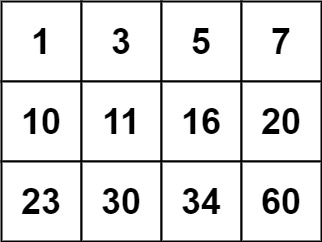
Input: matrix = [[1,3,5,7],[10,11,16,20],[23,30,34,60]], target = 13
Output: false
Solution: Binary Search (Row + In-Row)
class Solution {
public:
    // Binary search within a single sorted row
    bool binarySearchRow(const vector<int>& row, int target) {
        int l = 0, r = (int)row.size() - 1;
        while (l <= r) {
            int mid = l + (r - l) / 2; // avoid overflow
            if (row[mid] == target) return true;
            if (row[mid] < target) l = mid + 1;
            else r = mid - 1;
        }
        return false;
    }

    bool searchMatrix(vector<vector<int>>& matrix, int target) {
        int n = (int)matrix.size();
        if (n == 0) return false;
        int m = (int)matrix[0].size();
        if (m == 0) return false;

        int low = 0, high = n - 1;

        // Binary search on rows using first/last elements as guards
        while (low <= high) {
            int mid = low + (high - low) / 2;

            // If target cannot be in this row by range, move up/down
            if (target < matrix[mid][0]) {
                high = mid - 1;
            } else if (target > matrix[mid][m - 1]) {
                low = mid + 1;
            } else {
                // Target could be in this row — search inside the row once
                return binarySearchRow(matrix[mid], target);
            }
        }
        return false;
    }
};
📝 How It Works
- The matrix is sorted such that each row is non-decreasing and the first element of a row is greater than the last element of the previous row (LeetCode 74 property).
- We first binary search over rows:
- Compare
targetwith the first and last elements ofmatrix[mid]to decide if the target could lie in this row. - If
targetis outside the row’s range, movelow/highaccordingly.
- Compare
- Once we find a candidate row where
matrix[mid][0] ≤ target ≤ matrix[mid][m-1], we run a standard binary search inside that row. - This limits the inner search to one row at most, keeping the total work tight.
(Analogy: You’re looking for a book in a library arranged by ranges of titles per shelf (rows). First pick the correct shelf by checking its label range, then scan that shelf only.)
🧩 Key Formula / Transition
- Row selection invariant:
- If
target < matrix[mid][0]→ search upper half (rows beforemid) - If
target > matrix[mid][m-1]→ search lower half (rows aftermid) - Else → target can only be in this row → binary search within that row
- If
⏱️ Time & Space Complexity
-
Time:
O(log n + log m)(binary search over
nrows, then one binary search overmcolumns) -
Space:
O(1)(no extra data structures; pass rows by
const&)
Note: Your original code called binarySearch on the mid row in every row-iteration, leading to worst-case O(log n * log m) checks. Guarding with first/last narrows it to a single in-row search.
⚠️ Edge Cases
- Empty matrix (
n == 0) or empty row (m == 0). - Single row / single column matrices.
- Targets smaller than
matrix[0][0]or larger thanmatrix[n-1][m-1]. - Potential integer overflow when computing
mid→ uselow + (high - low) / 2.
💡 Other Approaches
-
Flattened Single Binary Search (Most Elegant) –
O(log(n*m)),O(1)- Treat the matrix as a 1D sorted array:
- Map
k → (row = k / m, col = k % m).
class Solution {
public:
    bool searchMatrix(vector<vector<int>>& matrix, int target) {
        int n = matrix.size();
        if (n == 0) return false;
        int m = matrix[0].size();
        if (m == 0) return false;

        int l = 0, r = n * m - 1;
        while (l <= r) {
            int mid = l + (r - l) / 2;
            int row = mid / m, col = mid % m;
            int val = matrix[row][col];

            if (val == target) return true;
            if (val < target) l = mid + 1;
            else r = mid - 1;
        }
        return false;
    }
}; -
Row-wise Linear Scan + In-row Binary Search –
O(n + log m)- Scan rows to find the candidate row, then binary search in it. Simpler but worse in the worst case.
🔁 Related Problems
- LeetCode 240: Search a 2D Matrix II (row & column sorted; two-pointer from top-right)
- LeetCode 34: Find First and Last Position of Element in Sorted Array (binary search variants)
- LeetCode 35: Search Insert Position (basic binary search pattern)