Ceil in Binary Search Tree
Problem Statement:
Given a BST and a number X, find Ceil of X.
Note: Ceil(X) is a number that is either equal to X or is immediately greater than X.
If Ceil could not be found, return -1.
Examples:
Input:root = [5, 1, 7, N, 2, N, N, N, 3], X = 3

Output:3
Explanation:We find 3 in BST, so ceil of 3 is 3.

Input:root = [10, 5, 11, 4, 7, N, N, N, N, N, 8], X = 6

Output:7
Explanation:We find 7 in BST, so ceil of 6 is 7.
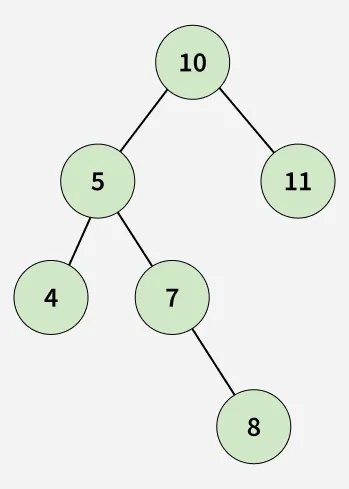
-
Example:
✅ Solution: Iterative
int findCeil(Node* root, int input) {
    int ceil = -1;

    while(root){
        if(root->data == input){
            // Found exact match — this is the ceil
            ceil = root->data;
            return ceil;
        }
        else if(input > root->data){
            // Move right to find a bigger or equal value
            root = root->right;
        }
        else{
            // Potential ceil found, move left to find smaller closer candidate
            ceil = root->data;
            root = root->left;
        }
    }
    return ceil;
}
📝 How It Works
- Start at the root.
- If the current node's value is equal to the target, it is the ceil.
- If the current node's value is less than the input, move right (need a larger number).
- If the current node's value is greater than the input, store it as a potential ceil and move left (to possibly find a smaller ceil).
- Repeat until you exhaust the tree.
🧩 Key Logic
The ceil of a number x in BST is the smallest number ≥ x.
- Use BST properties:
- Left < Node < Right
- Traverse accordingly.
⏱️ Time & Space Complexity
| Metric | Complexity |
|---|---|
| Time | O(H) |
| Space | O(1) |
Where H is the height of the tree — O(log N) for balanced BST, O(N) for skewed.
⚠️ Edge Cases
- No node ≥ input ⇒ return
1 - Exact match exists ⇒ return immediately
- Input is greater than all values ⇒ return
1 - Input is smaller than all values ⇒ return leftmost node
💡 Other Approaches
| Approach | Time | Space |
|---|---|---|
| Recursive | O(H) | O(H) (stack) |
| Brute Force (inorder traversal + binary search) | O(N) | O(N) |
🔁 Related Problems
- Leetcode 701: Insert into BST
- Find Floor in BST
- Kth smallest/largest element in BST
- Predecessor and Successor in BST
💬