Insertion in Binary Search Tree
Problem Statement:
You are given the root node of a binary search tree (BST) and a value to insert into the tree. Return the root node of the BST after the insertion. It is guaranteed that the new value does not exist in the original BST.
Notice that there may exist multiple valid ways for the insertion, as long as the tree remains a BST after insertion. You can return any of them.
Example 1:
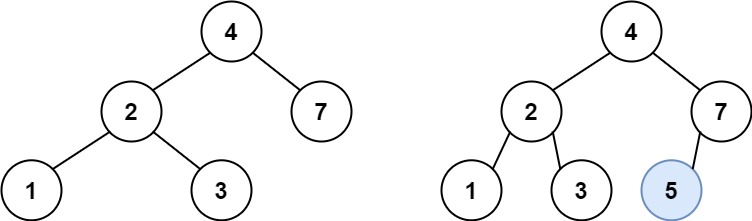
Input: root = [4,2,7,1,3], val = 5
Output: [4,2,7,1,3,5]
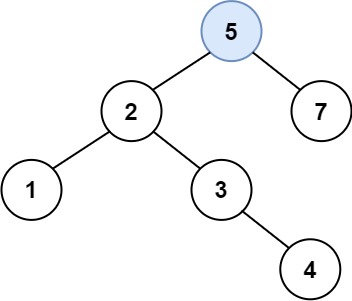
Explanation: Another accepted tree is:
Example 2:
Input: root = [40,20,60,10,30,50,70], val = 25
Output: [40,20,60,10,30,50,70,null,null,25]
Example 3:
Input: root = [4,2,7,1,3,null,null,null,null,null,null], val = 5
Output: [4,2,7,1,3,5]
-
Example:
✅ Solution: Recursive
TreeNode* insertIntoBST(TreeNode* root, int val) {
    if(root == NULL){
        // Create a new node when reaching the NULL spot
        return new TreeNode(val);
    }

    if(val < root->val){
        root->left = insertIntoBST(root->left, val);
    }
    else if(val > root->val){
        root->right = insertIntoBST(root->right, val);
    }

    return root;
}
✅ Solution: Iterative
TreeNode* insertIntoBST(TreeNode* root, int val) {
    TreeNode* newNode = new TreeNode(val);

    if(root == NULL) return newNode;

    TreeNode* curr = root;

    while(true){
        if(val < curr->val){
            if(curr->left == NULL){
                curr->left = newNode;
                break;
            }
            curr = curr->left;
        }
        else{
            if(curr->right == NULL){
                curr->right = newNode;
                break;
            }
            curr = curr->right;
        }
    }

    return root;
}
📝 How It Works
- Traverse the BST using binary search logic.
- If the value is smaller → go left.
- If greater → go right.
- Insert the node where the null pointer is encountered.
- Recursive version relies on stack, while iterative manages pointer manually.
🧩 Key Idea
Insert val into its correct sorted position in the BST so that the tree remains a valid binary search tree:
Left Subtree < Node < Right Subtree
⏱️ Time & Space Complexity
| Approach | Time | Space |
|---|---|---|
| Recursive | O(H) | O(H) (stack) |
| Iterative | O(H) | O(1) |
Where H = height of tree (O(log N) for balanced, O(N) for skewed).
⚠️ Edge Cases
- Inserting into an empty tree.
- Inserting duplicate value (this code ignores duplicates).
- Left/right subtree is null — insert directly.
💡 Other Approaches
- You can use Morris Traversal if required, but it's overkill here.
- Use an explicit stack to simulate recursion if iterative with stack is preferred.
🔁 Related Problems
- Search in BST
- Delete a node in BST
- Lowest Common Ancestor in BST
- BST to Balanced BST conversion
💬