Binary Search Tree Iterators
Problem Statement:
Implement the BSTIterator class that represents an iterator over the in-order traversal of a binary search tree (BST):
BSTIterator(TreeNode root)Initializes an object of theBSTIteratorclass. Therootof the BST is given as part of the constructor. The pointer should be initialized to a non-existent number smaller than any element in the BST.boolean hasNext()Returnstrueif there exists a number in the traversal to the right of the pointer, otherwise returnsfalse.int next()Moves the pointer to the right, then returns the number at the pointer.
Notice that by initializing the pointer to a non-existent smallest number, the first call to next() will return the smallest element in the BST.
You may assume that next() calls will always be valid. That is, there will be at least a next number in the in-order traversal when next() is called.
Example 1:
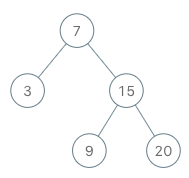
Input
["BSTIterator", "next", "next", "hasNext", "next", "hasNext", "next", "hasNext", "next", "hasNext"]
[[[7, 3, 15, null, null, 9, 20]], [], [], [], [], [], [], [], [], []]
Output
[null, 3, 7, true, 9, true, 15, true, 20, false]

Explanation
BSTIterator bSTIterator = new BSTIterator([7, 3, 15, null, null, 9, 20]);
bSTIterator.next();    // return 3
bSTIterator.next();    // return 7
bSTIterator.hasNext(); // return True
bSTIterator.next();    // return 9
bSTIterator.hasNext(); // return True
bSTIterator.next();    // return 15
bSTIterator.hasNext(); // return True
bSTIterator.next();    // return 20
bSTIterator.hasNext(); // return False
-
Example:
✅ Solution: Using Stack (In-Order Traversal Iterator)
class BSTIterator {
public:
    stack<TreeNode *> nodeStack;  // Stack to hold nodes

    // Constructor: Initialize iterator by pushing left path of root
    BSTIterator(TreeNode* root) {
        pushAllLeft(root);
    }

    // Returns the next smallest element in BST
    int next() {
        TreeNode *topNode = nodeStack.top();
        nodeStack.pop();

        // If there is a right child, push its left path
        if(topNode->right)
            pushAllLeft(topNode->right);

        return topNode->val;
    }

    // Checks if there is a next smallest element
    bool hasNext() {
        return !nodeStack.empty();
    }

private:
    // Helper function to push all left nodes of a subtree
    void pushAllLeft(TreeNode *node) {
        while(node != NULL) {
            nodeStack.push(node);
            node = node->left;
        }
    }
};
📝 Required Notes Template
📝 How It Works
- This class creates an iterator that returns the next smallest value in a BST each time
next()is called. - Internally, it uses a stack to simulate in-order traversal without recursion.
- During construction, it pushes all left nodes from the root to the stack.
- When
next()is called:- It pops the top node (smallest unvisited node so far).
- If that node has a right child, it pushes all its left descendants onto the stack.
hasNext()simply checks if the stack is non-empty.
🧩 Key Formula / Recurrence
-
No recurrence relation in this case.
-
Logic follows BST in-order traversal:
Left → Node → Right
⏱️ Time & Space Complexity
| Operation | Time Complexity | Space Complexity |
|---|---|---|
| Constructor | O(h) | O(h) |
| next() | Amortized O(1) | O(h) |
| hasNext() | O(1) | O(1) |
Where h = height of the BST.
- Worst-case space is O(N) if BST is skewed.
- Amortized O(1) for
next()because each node is pushed and popped only once.
⚠️ Edge Cases
- BST with only one node.
- Empty BST (root = NULL).
- Skewed BST (all nodes only on one side).
💡 Other Approaches
| Approach | Time Complexity | Space Complexity |
|---|---|---|
| Recursion (storing all elements first) | O(N) | O(N) |
| Morris Traversal (Threaded Binary Tree) | O(1) extra space | Alters tree structure, complex |
This stack-based iterator is the most common interview-friendly method.
🔁 Related Problems
- LeetCode 173. Binary Search Tree Iterator
- LeetCode 94. Binary Tree Inorder Traversal
- LeetCode 230. Kth Smallest Element in a BST
🛠️ Other Notes
- ✅ Real-world analogy: Imagine flipping through a sorted book index using sticky notes on the left-most pages.
- ✅ Preferred for interview use-cases due to simplicity and clarity.
- ✅ Maintains BST properties while allowing controlled traversal without full recursion.
💬