Recover Binary Search Tree
Problem Statement:
You are given the root of a binary search tree (BST), where the values of exactly two nodes of the tree were swapped by mistake. Recover the tree without changing its structure.
Example 1:
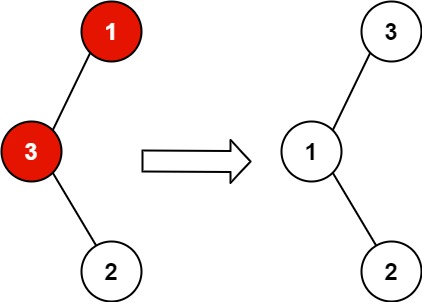
Input: root = [1,3,null,null,2]
Output: [3,1,null,null,2]
Explanation: 3 cannot be a left child of 1 because 3 > 1. Swapping 1 and 3 makes the BST valid.
Example 2:
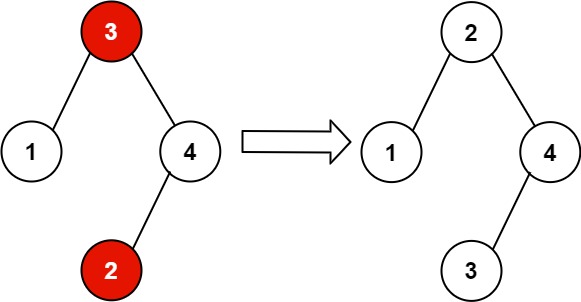
Input: root = [3,1,4,null,null,2]
Output: [2,1,4,null,null,3]
Explanation: 2 cannot be in the right subtree of 3 because 2 < 3. Swapping 2 and 3 makes the BST valid.
-
Example:
✅ Solution: Recover Binary Search Tree Using Inorder Traversal (Morris Traversal Style Observation)
/**
 * Definition for a binary tree node.
 * struct TreeNode {
 *     int val;
 *     TreeNode *left;
 *     TreeNode *right;
 *     TreeNode() : val(0), left(nullptr), right(nullptr) {}
 *     TreeNode(int x) : val(x), left(nullptr), right(nullptr) {}
 *     TreeNode(int x, TreeNode *left, TreeNode *right) : val(x), left(left), right(right) {}
 * };
 */

class Solution {
private:
    TreeNode *first;   // First incorrect node
    TreeNode *middle;  // Middle node for adjacent swap case
    TreeNode *last;    // Last incorrect node
    TreeNode *prev;    // Previously visited node in inorder traversal

public:
    void inorder(TreeNode *root) {
        if (root == NULL) return;

        inorder(root->left);

        // Detect swapped nodes during inorder traversal
        if (prev != NULL && root->val < prev->val) {
            if (!first) {
                first = prev;
                middle = root;
            } else {
                last = root;
            }
        }
        prev = root;

        inorder(root->right);
    }

    void recoverTree(TreeNode* root) {
        first = middle = last = NULL;
        prev = new TreeNode(INT_MIN); // Initialize prev with the smallest possible value

        inorder(root);

        // Swap values back to fix the BST
        if (first && last) swap(first->val, last->val);
        else if (first && middle) swap(first->val, middle->val);
    }
};
✅ Structured Revision Notes
📝 How It Works
- Problem: Two nodes of a BST are swapped by mistake. Recover the tree without changing its structure.
- Idea: In-order traversal of a BST gives a sorted sequence.
- If two nodes are swapped:
- One or two violations will occur in the in-order sequence.
- We track these violations using four pointers:
first: First node whereprev->val > root->valis detected.middle: Node right afterfirstin violation.last: Second violation node (if not adjacent).prev: Keeps track of the last visited node.
- After traversal:
- If
firstandlastare found → swap their values. - If only
firstandmiddleare found (adjacent swap) → swap their values.
- If
🧩 Key Formula / Recurrence
- In-order property:
prev->val <= current->valmust hold true in all steps. - Detect violations:
- First violation →
first = prev,middle = root - Second violation →
last = root
- First violation →
⏱️ Time & Space Complexity
| Metric | Complexity |
|---|---|
| Time | O(N) |
| Space | O(h) |
- N = number of nodes in the tree.
- Space is due to recursion stack (height of BST = h).
- Morris Traversal can reduce space to O(1) but is more complex.
⚠️ Edge Cases
- Swapped nodes are adjacent (e.g., 1 3 2 4).
- Swapped nodes are far apart (e.g., 1 4 3 2 5).
- Tree with only two nodes (swapped).
💡 Other Approaches
| Approach | Time | Space | Notes |
|---|---|---|---|
| Inorder + Array | O(N) | O(N) | Store inorder values, sort, refill |
| Morris Traversal | O(N) | O(1) | Space optimized, no recursion |
🔁 Related Problems
- LeetCode 99: Recover Binary Search Tree
- LeetCode 530: Minimum Absolute Difference in BST
- LeetCode 501: Find Mode in Binary Search Tree
✅ Real-World Analogy
Imagine a sorted bookshelf where two books were accidentally placed in the wrong position. Scanning left to right, you would notice breaks in order and fix them by swapping.
💬