Predecessor and Successor in Binary Search Tree
Problem Statement:
You are given root node of the BST and an integer key. You need to find the in-order successor and predecessor of the given key. If either predecessor or successor is not found, then set it to NULL.
Note:- In an inorder traversal the number just smaller than the target is the predecessor and the number just greater than the target is the successor.
Examples :
Input:root[] = [8, 1, 9, N, 4, N, 10, 3, N, N, N], key = 8
Output:4 9
Explanation:In the given BST the inorder predecessor of 8 is 4 and inorder successor of 8 is 9.

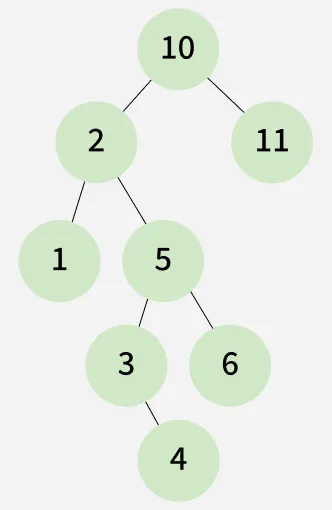
Input:root[] = [10, 2, 11, 1, 5, N, N, N, N, 3, 6, N, 4, N, N], key = 11
Output:10 -1
Explanation:In given BST, the inorder predecessor of 11 is 10 whereas it does not have any inorder successor.
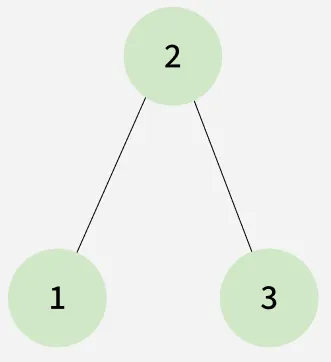
Input:root[] = [2, 1, 3], key = 3
Output:2 -1
Explanation: In given BST, the inorder predecessor of 3 is 2 whereas it does not have any inorder successor.
-
Example:
✅ Solution: Recursive/Iterative Hybrid (Using BST Properties)
class Solution {
  public:
    Node* findPre(Node* root, int key) {
        Node* predecessor = NULL;
        Node* current = root;

        while (current) {
            if (current->data < key) {
                predecessor = current;
                current = current->right;
            } else if (current->data > key) {
                current = current->left;
            } else break;
        }

        if (current != NULL && current->left) {
            Node* temp = current->left;
            while (temp->right) {
                temp = temp->right;
            }
            return temp;
        }

        return predecessor;
    }

    Node* findSuc(Node* root, int key) {
        Node* successor = NULL;
        Node* current = root;

        while (current) {
            if (current->data < key) {
                current = current->right;
            } else if (current->data > key) {
                successor = current;
                current = current->left;
            } else break;
        }

        if (current != NULL && current->right) {
            Node* temp = current->right;
            while (temp->left) {
                temp = temp->left;
            }
            return temp;
        }

        return successor;
    }

    vector<Node*> findPreSuc(Node* root, int key) {
        vector<Node*> res;
        res.push_back(findPre(root, key));
        res.push_back(findSuc(root, key));
        return res;
    }
};
📝 How It Works
- Predecessor: Largest value less than key.
- Traverse towards right when possible, tracking the last valid predecessor.
- If exact node found, look into its left subtree’s rightmost node.
- Successor: Smallest value greater than key.
- Traverse towards left when possible, tracking the last valid successor.
- If exact node found, look into its right subtree’s leftmost node.
🧩 Key Observations
-
For predecessor:
While traversing, if
node->data < key, storenodeand move right. -
For successor:
While traversing, if
node->data > key, storenodeand move left.
⏱️ Time & Space Complexity
| Metric | Complexity |
|---|---|
| Time | O(H) |
| Space | O(1) |
Where H is the height of the BST → O(log N) for balanced BST.
⚠️ Edge Cases
- Key not present in BST → predecessor and successor are calculated based on nearest smaller/larger value.
- Tree with only one node → both predecessor and successor are
NULL. - Key is the smallest/largest value in BST → one of predecessor or successor will be
NULL.
💡 Other Approaches
| Method | Time | Space | Notes |
|---|---|---|---|
| Full Inorder Traversal | O(N) | O(N) | Simple but not BST optimized |
| ✅ BST Property Based | O(H) | O(1) | Efficient for BST |
🔁 Related Problems
- Leetcode 285: Inorder Successor in BST
- Leetcode 510: Inorder Successor in BST II
- Predecessor in BST problem
- Find Floor and Ceil in BST
💬