Binary Tree Levelorder Traversal
Problem Statement:
Given the root of a binary tree, return the level order traversal of its nodes' values. (i.e., from left to right, level by level).
Example 1:
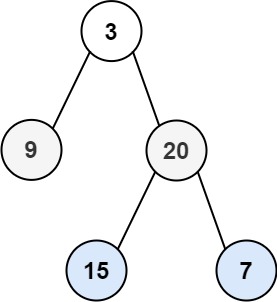
Input: root = [3,9,20,null,null,15,7]
Output: [[3],[9,20],[15,7]]
-
Example:
✅ Solution: Level Order Traversal (BFS using Queue)
class Solution {
public:
    vector<vector<int>> levelOrder(TreeNode* root) {
        vector<vector<int>> res;
        if(root == NULL) return res;

        queue<TreeNode*> Q;
        Q.push(root);

        while(!Q.empty()) {
            int size = Q.size();          // Number of nodes in the current level
            vector<int> temp;

            for(int i = 0; i < size; i++) {
                TreeNode* node = Q.front(); Q.pop();

                if(node->left)  Q.push(node->left);   // Enqueue left child
                if(node->right) Q.push(node->right);  // Enqueue right child

                temp.push_back(node->val); // Add node value to current level
            }

            res.push_back(temp); // Push current level to result
        }

        return res;
    }
};
📝 How It Works
- This is a Breadth-First Search traversal.
- It uses a queue to visit each level of the tree from top to bottom.
- For each level:
- Record the number of nodes (
size). - Process all those nodes:
- Add their children to the queue.
- Store their values in a temporary list for that level.
- Record the number of nodes (
- After processing a level, push the collected values into the final result.
🧩 Key Idea
Traverse the tree level by level using a queue: enqueue children, dequeue parent.
⏱️ Time & Space Complexity
| Metric | Complexity |
|---|---|
| ⏱️ Time | O(n) — visit every node once |
| 🪄 Space | O(w) — where w is the maximum width of the tree (i.e., max queue size) |
⚠️ Edge Cases
- ✅ Empty tree → returns empty list
- ✅ Tree with only one node → returns list with single list
- ✅ Left-skewed or right-skewed tree → each level contains only one node
💡 Other Approaches
| Approach | Notes |
|---|---|
| Recursive Level Order | Use DFS with level tracking, harder to manage |
| Zigzag Level Order | Variation using deque or direction toggle |
🔁 Related Problems
- LeetCode 102. Binary Tree Level Order Traversal
- LeetCode 103. Binary Tree Zigzag Level Order Traversal
- LeetCode 107. Binary Tree Level Order Traversal II
- LeetCode 429. N-ary Tree Level Order Traversal
💬