Construct Binary Tree from Preorder and Inorder Traversal
Problem Statement:
Given two integer arrays preorder and inorder where preorder is the preorder traversal of a binary tree and inorder is the inorder traversal of the same tree, construct and return the binary tree.
Example 1:
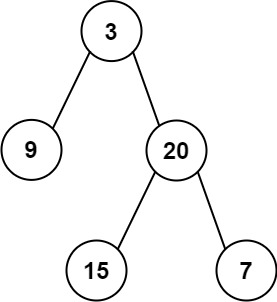
Input: preorder = [3,9,20,15,7], inorder = [9,3,15,20,7]
Output: [3,9,20,null,null,15,7]
Example 2:
Input: preorder = [-1], inorder = [-1]
Output: [-1]
-
Example:
✅ Solution: Recursive Tree Construction from Inorder and Preorder
/**
 * Definition for a binary tree node.
 * struct TreeNode {
 *     int val;
 *     TreeNode *left;
 *     TreeNode *right;
 *     TreeNode() : val(0), left(nullptr), right(nullptr) {}
 *     TreeNode(int x) : val(x), left(nullptr), right(nullptr) {}
 *     TreeNode(int x, TreeNode *left, TreeNode *right) : val(x), left(left), right(right) {}
 * };
 */
class Solution {
public:
    // Recursive function to construct binary tree
    TreeNode* construction(vector<int> &preorder, int preStart, int preEnd,
                           vector<int> &inorder, int inStart, int inEnd,
                           map<int, int> &inorderIndexMap) {

        if (preStart > preEnd || inStart > inEnd) return NULL;

        // First element in preorder is root
        TreeNode* root = new TreeNode(preorder[preStart]);

        // Index of root in inorder traversal
        int inRootIndex = inorderIndexMap[root->val];

        // Number of elements in left subtree
        int leftSubtreeSize = inRootIndex - inStart;

        // Recursively construct left and right subtrees
        root->left = construction(preorder, preStart + 1, preStart + leftSubtreeSize,
                                  inorder, inStart, inRootIndex - 1, inorderIndexMap);

        root->right = construction(preorder, preStart + leftSubtreeSize + 1, preEnd,
                                   inorder, inRootIndex + 1, inEnd, inorderIndexMap);

        return root;
    }

    // Main function to build tree
    TreeNode* buildTree(vector<int>& preorder, vector<int>& inorder) {
        map<int, int> inorderIndexMap;

        // Store indices of inorder elements for quick lookup
        for (int i = 0; i < inorder.size(); i++) {
            inorderIndexMap[inorder[i]] = i;
        }

        return construction(preorder, 0, preorder.size() - 1,
                            inorder, 0, inorder.size() - 1,
                            inorderIndexMap);
    }
};
📝 How It Works
- The first element of
preorderis always the root of the (sub)tree. - Locate this root in the
inorderarray to divide the array into left and right subtrees. - Recursively repeat this process for the left and right halves of the inorder array, updating corresponding ranges in the preorder array.
🧩 Key Concept
- Preorder Traversal:
[root] [left subtree] [right subtree] - Inorder Traversal:
[left subtree] [root] [right subtree] - Using the root’s index in inorder, we split the array and determine the size of left subtree.
⏱️ Time & Space Complexity
| Metric | Complexity |
|---|---|
| Time | O(N) – Each node processed once |
| Space | O(N) – Map + recursion stack |
⚠️ Edge Cases
- Empty tree (
preorderorinorderis empty) - Only one node → correctly handled
- Left-skewed or right-skewed trees → handled via recursion
💡 Other Approaches
| Approach | Time | Space | Notes |
|---|---|---|---|
| Recursive (this) ✅ | O(N) | O(N) | Optimal for tree construction |
| Iterative with Stack | O(N) | O(N) | More complex logic |
🔁 Related Problems
- Leetcode 105: Construct Binary Tree from Preorder and Inorder
- Leetcode 106: Construct from Inorder and Postorder
- Leetcode 889: Construct from Preorder and Postorder
- GFG: Tree from Inorder and Preorder
💬