Serialize and Deserialize Binary Tree
Problem Statement:
Serialization is the process of converting a data structure or object into a sequence of bits so that it can be stored in a file or memory buffer, or transmitted across a network connection link to be reconstructed later in the same or another computer environment.
Design an algorithm to serialize and deserialize a binary tree. There is no restriction on how your serialization/deserialization algorithm should work. You just need to ensure that a binary tree can be serialized to a string and this string can be deserialized to the original tree structure.
Clarification: The input/output format is the same as how LeetCode serializes a binary tree. You do not necessarily need to follow this format, so please be creative and come up with different approaches yourself.
Example 1:
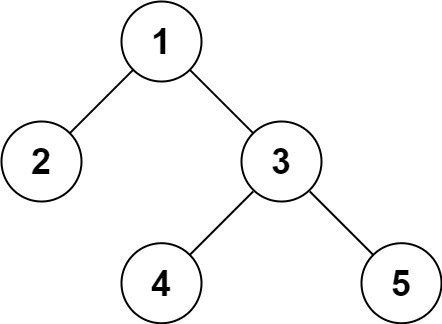
Input: root = [1,2,3,null,null,4,5]
Output: [1,2,3,null,null,4,5]
Example 2:
Input: root = []
Output: []
-
Example:
✅ Solution: Level Order (BFS) Based Serialization and Deserialization
/**
 * Definition for a binary tree node.
 * struct TreeNode {
 *     int val;
 *     TreeNode *left;
 *     TreeNode *right;
 *     TreeNode(int x) : val(x), left(NULL), right(NULL) {}
 * };
 */
class Codec {
public:

    // Encodes a binary tree to a single string using level-order traversal
    string serialize(TreeNode* root) {
        if (!root) return "";

        string s = "";
        queue<TreeNode*> q;
        q.push(root);

        while (!q.empty()) {
            TreeNode *node = q.front();
            q.pop();

            if (node == NULL) {
                s += "#,"; // '#' represents null node
            } else {
                s += to_string(node->val) + ','; // append current node's value
                q.push(node->left);  // enqueue left child
                q.push(node->right); // enqueue right child
            }
        }
        return s;
    }

    // Decodes the serialized string back to binary tree
    TreeNode* deserialize(string data) {
        if (data.empty()) return NULL;

        stringstream s(data);
        string str;

        getline(s, str, ',');
        TreeNode *root = new TreeNode(stoi(str)); // create root

        queue<TreeNode*> q;
        q.push(root);

        while (!q.empty()) {
            TreeNode *curr = q.front();
            q.pop();

            // Get left child value
            getline(s, str, ',');
            if (str != "#") {
                TreeNode *leftNode = new TreeNode(stoi(str));
                curr->left = leftNode;
                q.push(curr->left);
            }

            // Get right child value
            getline(s, str, ',');
            if (str != "#") {
                TreeNode *rightNode = new TreeNode(stoi(str));
                curr->right = rightNode;
                q.push(curr->right);
            }
        }

        return root;
    }
};

// Usage:
// Codec ser, deser;
// TreeNode* ans = deser.deserialize(ser.serialize(root));
📝 How It Works
✅ Serialization:
- Traverse the tree using level-order (BFS).
- For every node:
- If it exists → append its value to the string.
- If it’s null → append
"#"to represent a missing child.
- Use comma
,as a separator.
✅ Deserialization:
- Read the serialized string using
stringstreamandgetline. - Reconstruct the tree level by level.
- Use a queue to keep track of parents and link their left and right children as you parse values.
🧩 Key Design
- Use "#" to represent
NULLnodes explicitly. - Maintain order of insertion to ensure tree structure is preserved during decode.
⏱️ Time & Space Complexity
| Operation | Time | Space |
|---|---|---|
| Serialize (BFS) | O(N) | O(N) |
| Deserialize (BFS) | O(N) | O(N) |
Nis the number of nodes in the tree.
⚠️ Edge Cases
- Empty tree → serialized as empty string
"", deserialized asNULL. - Tree with only one node → handled correctly.
- Trees with null children at various positions → supported by
"#"markers.
💡 Other Approaches
| Approach | Time | Space | Comment |
|---|---|---|---|
| BFS (Level Order) ✅ | O(N) | O(N) | Simple, clear structure |
| DFS (Preorder) | O(N) | O(H) | More compact, recursive design |
| DFS (Postorder) | O(N) | O(H) | Good for symmetric trees |
🔁 Related Problems
- Leetcode 297: Serialize and Deserialize Binary Tree
- Leetcode 449: Serialize and Deserialize BST
- Leetcode 116: Populating Next Right Pointers