Check if Binary Tree is Height Balanced or Not
Problem Statement:
Given a binary tree, determine if it is height-balanced.
Example 1:
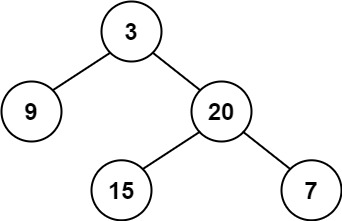
Input: root = [3,9,20,null,null,15,7]
Output: true
Example 2:
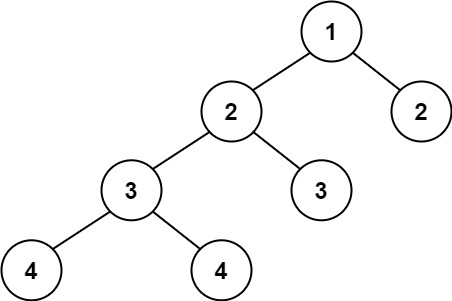
Input: root = [1,2,2,3,3,null,null,4,4]
Output: false
Example 3:
Input: root = []
Output: true
-
Example:
✅ Solution 1: Naive Recursive Approach (Height + Balance Check Separately)
class Solution {
public:
    int getHeight(TreeNode *root){
        if(root == NULL) return 0;
        return 1 + max(getHeight(root->left), getHeight(root->right));
    }

    bool solve(TreeNode *root){
        if(root == NULL) return true;

        int leftHeight  = getHeight(root->left);
        int rightHeight = getHeight(root->right);

        if(abs(leftHeight - rightHeight) <= 1 &&
           solve(root->left) && solve(root->right))
            return true;

        return false;
    }

    bool isBalanced(TreeNode* root) {
        return solve(root);
    }
};
✅ Solution 2: Optimized DFS Approach (Postorder Height + Balance Check in One Pass)
class Solution {
public:
    int dfsHeight(TreeNode *root){
        if(root == NULL) return 0;

        int leftHeight = dfsHeight(root->left);
        if(leftHeight == -1) return -1;  // left subtree is unbalanced

        int rightHeight = dfsHeight(root->right);
        if(rightHeight == -1) return -1; // right subtree is unbalanced

        if(abs(leftHeight - rightHeight) > 1)
            return -1; // current node is unbalanced

        return 1 + max(leftHeight, rightHeight); // return height if balanced
    }

    bool isBalanced(TreeNode* root) {
        return dfsHeight(root) != -1;
    }
};
📝 How It Works
Naive Approach:
- At each node:
- Compute the height of left and right subtrees.
- Check if difference is ≤ 1.
- Recurse on both subtrees.
- Problem:
getHeight()is called for each node, resulting in repeated work.
Optimized DFS:
- Do a postorder traversal.
- While calculating height, check if the subtree is balanced.
- If any subtree is unbalanced, propagate
1immediately to stop early. - This avoids redundant height computations.
🧩 Key Formula
Height = 1 + max(leftHeight, rightHeight)
Unbalanced if
abs(leftHeight - rightHeight) > 1
⏱️ Time & Space Complexity
| Approach | Time Complexity | Space Complexity |
|---|---|---|
| Naive Recursive | O(n²) | O(h) |
| Optimized DFS | O(n) ✅ | O(h) |
n: number of nodesh: height of tree
⚠️ Edge Cases
- ✅ Empty tree → considered balanced
- ✅ Tree with one node → balanced
- ✅ Skewed tree → returns
false - ✅ Perfectly balanced binary tree → returns
true
💡 Other Approaches
| Approach | Notes |
|---|---|
| Bottom-up DFS | ✅ Optimal and clean (used above) |
| Top-down DFS | Like naive, less efficient |
| BFS with height map | Possible, but adds extra storage overhead |
🔁 Related Problems
- LeetCode 110. Balanced Binary Tree
- LeetCode 104. Maximum Depth of Binary Tree
- LeetCode 543. Diameter of Binary Tree
- LeetCode 124. Binary Tree Maximum Path Sum
Let me know if you’d like to extend this to checking if a tree is a complete binary tree or other tree properties!
💬