Diagonal Tree Traversal
Problem Statement:
Given a Binary Tree, return the diagonal traversal of the binary tree.
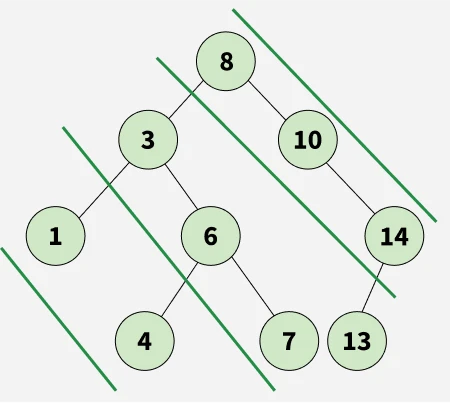
Consider lines of slope -1 passing between nodes. Given a Binary Tree, return a single list containing all diagonal elements in a binary tree belonging to same line.If the diagonal element are present in two different subtrees then left subtree diagonal element should be taken first and then right subtree.
-
Example:
Examples :
Input : root = [8, 3, 10, 1, 6, N, 14, N, N, 4, 7, 13]

Output : [8, 10, 14, 3, 6, 7, 13, 1, 4]
Explanation:

Diagonal Traversal of binary tree : 8 10 14 3 6 7 13 1 4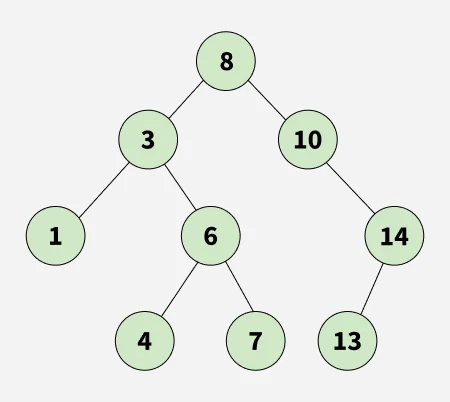
Input: root = [1, 2, N, 3, N]

Output: [1, 2, 3]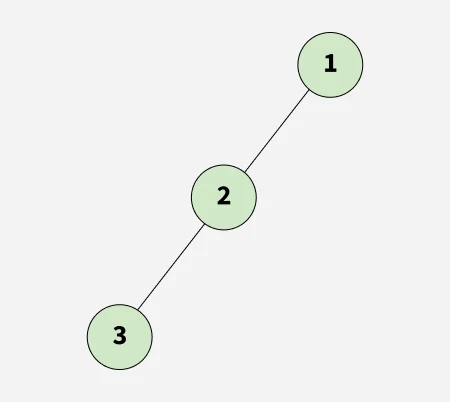
Solution: DFS with Level Mapping (Diagonal Indexing)
/* A binary tree node
struct Node{
    int data;
    Node *left, *right;
}; */

class Solution {
  public:
    // Collect nodes grouped by their diagonal index.
    // Rule: moving right keeps you on the same diagonal,
    //       moving left moves you to the next diagonal (index + 1).
    void collectDiagonal(Node* node,
                         int diagonalIndex,
                         unordered_map<int, vector<int>>& groups,
                         int &maxDiagonal) {
        if (!node) return;

        groups[diagonalIndex].push_back(node->data);
        maxDiagonal = max(maxDiagonal, diagonalIndex);

        // Visit right first to preserve expected diagonal order (root->right chain first)
        collectDiagonal(node->right, diagonalIndex, groups, maxDiagonal);      // same diagonal
        collectDiagonal(node->left, diagonalIndex + 1, groups, maxDiagonal);   // next diagonal
    }

    vector<int> diagonal(Node *root) {
        if (!root) return {};

        unordered_map<int, vector<int>> groups;
        int maxDiagonal = 0;

        collectDiagonal(root, 0, groups, maxDiagonal);

        // Flatten diagonals in order: 0, 1, 2, ...
        vector<int> traversal;
        traversal.reserve(groups.size()); // rough reserve
        for (int d = 0; d <= maxDiagonal; ++d) {
            if (groups.count(d)) {
                // Append nodes of diagonal d preserving insertion order
                for (int value : groups[d]) traversal.push_back(value);
            }
        }
        return traversal;
    }
};
Alternative Solution: Iterative Queue (BFS-Style)
/* A binary tree node
struct Node{
    int data;
    Node *left, *right;
}; */

class Solution {
  public:
    // Classic iterative approach:
    // Use a queue to store left children while walking right chains.
    vector<int> diagonal(Node *root) {
        if (!root) return {};

        vector<int> traversal;
        queue<Node*> pending;      // holds the next starting points (left children)
        pending.push(root);

        while (!pending.empty()) {
            Node* current = pending.front();
            pending.pop();

            // Walk the entire right chain from 'current'
            while (current) {
                traversal.push_back(current->data);
                if (current->left) {
                    // Left child starts a new diagonal later
                    pending.push(current->left);
                }
                current = current->right; // stay on the same diagonal
            }
        }
        return traversal;
    }
};
📝 How It Works
- Think of each diagonal as moving along right pointers; going left bumps you to the next diagonal.
- DFS version groups nodes by
diagonalIndex:- Right child ⇒ same
diagonalIndex - Left child ⇒
diagonalIndex + 1 - We visit right first to match expected order (root-right chain before diving left).
- Right child ⇒ same
- BFS version:
- Keep a queue of left children.
- For each queued node, traverse its entire right chain, pushing each node’s left child to the queue for later.
- Naturally yields diagonal-by-diagonal order.
🧩 Key Formula / Recurrence
- If
diag(u)is the diagonal index of nodeu:diag(u->right) = diag(u)diag(u->left) = diag(u) + 1
⏱️ Time & Space Complexity
- Time:
O(N)for both approaches (each node is visited once). - Space:
- DFS +
unordered_map:O(N)for storing groups + recursion stackO(H). - BFS (queue):
O(W)whereWis max number of nodes held across diagonals (≤N).
- DFS +
⚠️ Edge Cases
- Empty tree ⇒ return empty vector.
- Single-node tree ⇒ return
{root->data}. - Right-skewed tree ⇒ all nodes on the same diagonal.
- Left-skewed tree ⇒ each node on a new diagonal (indices 0..H-1).
- Using
unordered_mapdemands we emit diagonals in order (0..max); iterating map directly would be unordered.
💡 Other Approaches
- Use
std::map<int, vector<int>>to keep diagonals auto-sorted by key (simplifies emission order; slightly higher overhead). - Compute Diagonal Sums instead of traversal using the same indexing trick (replace vector with running sum).
- Morris-style variants exist but add complexity with limited benefit here.
🔁 Related Problems
- Vertical Order Traversal of Binary Tree
- Top View / Bottom View of Binary Tree
- Boundary Traversal of Binary Tree
💬