Lowest Common Ancestor of a Binary Tree
Problem Statement:
Given a binary tree, find the lowest common ancestor (LCA) of two given nodes in the tree.
According to the definition of LCA on Wikipedia: “The lowest common ancestor is defined between two nodes p and q as the lowest node in T that has both p and q as descendants (where we allow a node to be a descendant of itself).”
Example 1:
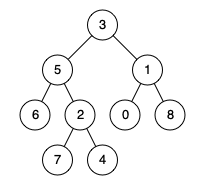
Input: root = [3,5,1,6,2,0,8,null,null,7,4], p = 5, q = 1
Output: 3
Explanation: The LCA of nodes 5 and 1 is 3.
Example 2:
Input: root = [3,5,1,6,2,0,8,null,null,7,4], p = 5, q = 4
Output: 5
Explanation: The LCA of nodes 5 and 4 is 5, since a node can be a descendant of itself according to the LCA definition.
Example 3:
Input: root = [1,2], p = 1, q = 2
Output: 1
-
Example:
✅ Solution: Recursive DFS – Postorder Traversal
class Solution {
public:
    // Recursive function to find LCA of nodes p and q
    TreeNode* lowestCommonAncestor(TreeNode* currentNode, TreeNode* p, TreeNode* q) {
        // Base Case: found one of the nodes or reached the end
        if(currentNode == NULL || currentNode == p || currentNode == q)
            return currentNode;

        // Recurse for left and right subtree
        TreeNode* leftLCA = lowestCommonAncestor(currentNode->left, p, q);
        TreeNode* rightLCA = lowestCommonAncestor(currentNode->right, p, q);

        // If one node found in left and one in right, current is LCA
        if(leftLCA != NULL && rightLCA != NULL)
            return currentNode;

        // Otherwise, return non-null value
        return leftLCA != NULL ? leftLCA : rightLCA;
    }
};
📝 How It Works
- This is a postorder traversal approach (left → right → root).
- At each node, recursively check if
porqis found in the left and right subtree. - Three key base cases:
- If current node is
NULL, returnNULL. - If current node is
porq, return that node.
- If current node is
- If both left and right subtrees return non-null, it means:
- One node was found in each subtree → current node is Lowest Common Ancestor (LCA).
- If only one side returns non-null, that means both
pandqlie in that subtree.
🧩 Key Logic
if (left != NULL && right != NULL)
    return root;
else
    return left != NULL ? left : right;
⏱️ Time & Space Complexity
| Metric | Value |
|---|---|
| Time | O(N) — visit each node once |
| Space | O(H) — recursion stack (H = height of tree) |
⚠️ Edge Cases
p == q→ returnsporq.- One node is the ancestor of the other.
- Skewed trees (linked-list like) still work.
- Tree is empty → returns
NULL.
💡 Other Approaches
| Approach | Time | Space | Notes |
|---|---|---|---|
| DFS Recursion ✅ | O(N) | O(H) | Clean and elegant |
| Path-based Method | O(N) | O(N) | Store paths to p and q, then compare |
Path-based is helpful if the tree is not binary or is stored externally.
🔁 Related Problems
- Leetcode 236. Lowest Common Ancestor of a Binary Tree
- Leetcode 235. LCA of BST (optimized for BST)
- Leetcode 112. Path Sum
- GFG: LCA in Binary Tree
💬