Maximum Sum Path
Problem Statement:
A path in a binary tree is a sequence of nodes where each pair of adjacent nodes in the sequence has an edge connecting them. A node can only appear in the sequence at most once. Note that the path does not need to pass through the root.
The path sum of a path is the sum of the node's values in the path.
Given the root of a binary tree, return the maximum path sum of any non-empty path.
Example 1:
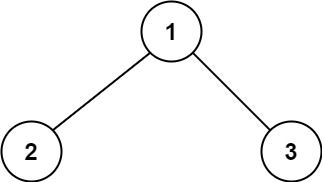
Input: root = [1,2,3]
Output: 6
Explanation: The optimal path is 2 -> 1 -> 3 with a path sum of 2 + 1 + 3 = 6.
Example 2:
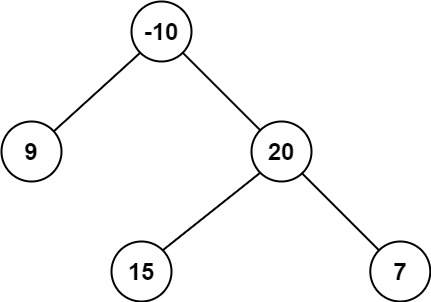
Input: root = [-10,9,20,null,null,15,7]
Output: 42
Explanation: The optimal path is 15 -> 20 -> 7 with a path sum of 15 + 20 + 7 = 42.
-
Example:
✅ Solution: Postorder DFS (Max Path Sum via Recursion)
class Solution {
public:
    int findMaxPathSum(TreeNode *root, int &sum){
        if(root == NULL) return 0;

        // Only consider positive contributions; discard negatives
        int leftMaxPath = max(0, findMaxPathSum(root->left, sum));
        int rightMaxPath = max(0, findMaxPathSum(root->right, sum));

        // Update global max: current node as the root of the path
        sum = max(sum, leftMaxPath + rightMaxPath + root->val);

        // Return max path sum including current node and one subtree
        return root->val + max(leftMaxPath, rightMaxPath);
    }

    int maxPathSum(TreeNode* root) {
        int sum = INT_MIN;
        findMaxPathSum(root, sum);
        return sum;
    }
};
📝 How It Works
- This problem finds the maximum sum path between any two nodes in a binary tree.
- At each node:
- Compute the max path sum from left and right subtrees.
- Ignore negative paths by using
max(0, …)to avoid reducing total sum. - Update the global max (
sum) withleft + right + root->val(when the path goes through the current node).
- Finally, return the maximum one-sided path sum that can be extended upwards (used in recursive return).
🧩 Key Formula
// 1. Local sum at current node
sum = max(sum, left + right + root->val);

// 2. Return to parent only one side (left or right path)
return root->val + max(left, right);
⏱️ Time & Space Complexity
| Metric | Value |
|---|---|
| ⏱️ Time Complexity | O(n) — each node visited once |
| 🪄 Space Complexity | O(h) — recursion stack (h = height) |
⚠️ Edge Cases
- ✅ Tree with all negative nodes → picks the least negative node
- ✅ Tree with one node → returns node value
- ✅ Balanced and skewed trees → handled properly
💡 Other Approaches
| Approach | Notes |
|---|---|
| Brute Force | Exponential, very inefficient |
| DFS with global tracking ✅ | Optimal, clean, used here |
🔁 Related Problems
- LeetCode 124. Binary Tree Maximum Path Sum
- LeetCode 543. Diameter of Binary Tree
- LeetCode 687. Longest Univalue Path
- LeetCode 437. Path Sum III
💬