Maximum Width of Binary Tree
Problem Statement:
Given the root of a binary tree, return the maximum width of the given tree.
The maximum width of a tree is the maximum width among all levels.
The width of one level is defined as the length between the end-nodes (the leftmost and rightmost non-null nodes), where the null nodes between the end-nodes that would be present in a complete binary tree extending down to that level are also counted into the length calculation.
It is guaranteed that the answer will in the range of a 32-bit signed integer.
Example 1:
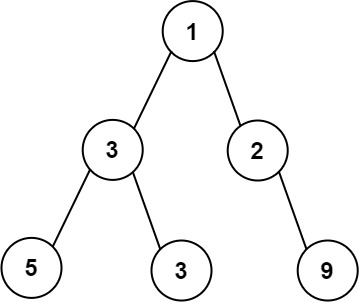
Input: root = [1,3,2,5,3,null,9]
Output: 4
Explanation: The maximum width exists in the third level with length 4 (5,3,null,9).
Example 2:
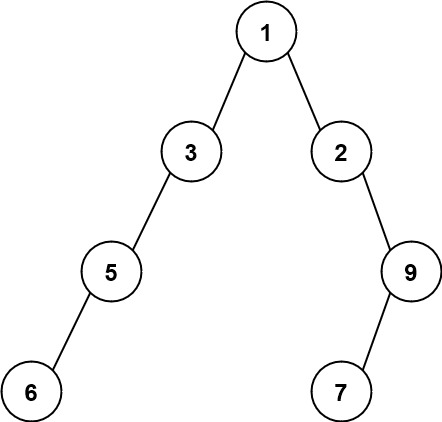
Input: root = [1,3,2,5,null,null,9,6,null,7]
Output: 7
Explanation: The maximum width exists in the fourth level with length 7 (6,null,null,null,null,null,7).
-
Example:
✅ Solution: Level Order Traversal (BFS with Indexing)
class Solution {
public:
    int widthOfBinaryTree(TreeNode* root) {
        // Queue stores node and its index based on complete binary tree rules
        queue<pair<TreeNode*, long long>> qu;
        long long maxWidth = INT_MIN;

        qu.push({root, 0}); // Start with root node at index 0

        while (!qu.empty()) {
            int levelSize = qu.size();
            long long minIndex = qu.front().second; // Index normalization to avoid overflow

            long long firstIndex = 0, lastIndex = 0;

            for (int i = 0; i < levelSize; i++) {
                auto currentPair = qu.front();
                TreeNode* currentNode = currentPair.first;
                long long currIndex = currentPair.second - minIndex; // Normalize to 0-based index
                qu.pop();

                if (i == 0) firstIndex = currIndex;
                if (i == levelSize - 1) lastIndex = currIndex;

                if (currentNode->left) {
                    qu.push({currentNode->left, 2 * currIndex + 1}); // Left child index
                }
                if (currentNode->right) {
                    qu.push({currentNode->right, 2 * currIndex + 2}); // Right child index
                }
            }

            // Update maximum width for this level
            maxWidth = max(maxWidth, lastIndex - firstIndex + 1);
        }

        return maxWidth;
    }
};
📝 How It Works
- Performs level order traversal (BFS) while keeping track of node indices based on complete binary tree rules:
- Left child index =
2 * idx + 1 - Right child index =
2 * idx + 2
- Left child index =
- At each level, the first and last index are recorded to compute width.
- The index is normalized (shifted) by subtracting
minIndexto prevent overflow. - Width =
lastIndex - firstIndex + 1
🧩 Key Formula
- Child Indexing (like heap):
- Left:
2 * i + 1 - Right:
2 * i + 2
- Left:
- Width of level =
last - first + 1
⏱️ Time & Space Complexity
| Metric | Complexity |
|---|---|
| Time | O(N) – Each node visited once |
| Space | O(N) – For queue storing nodes |
⚠️ Edge Cases
- Skewed trees (all left or right) → width is always 1
- Sparse trees → width is calculated based on position, not node count
💡 Other Approaches
| Approach | Time | Space | Comment |
|---|---|---|---|
| BFS + Indexing ✅ | O(N) | O(N) | Best for full/sparse width |
| DFS with map (level to first index) | O(N) | O(H) | Needs extra logic to track min/max |
🔁 Related Problems
- Leetcode 662: Maximum Width of Binary Tree
- Leetcode 102: Binary Tree Level Order Traversal
- Leetcode 515: Find Largest Value in Each Tree Row
💬