Root to Leaf Paths
Problem Statement:
Given a Binary Tree, you need to find all the possible paths from the root node to all the leaf nodes of the binary tree.
Note: The paths should be returned such that paths from the left subtree of any node are listed first, followed by paths from the right subtree.
Examples:
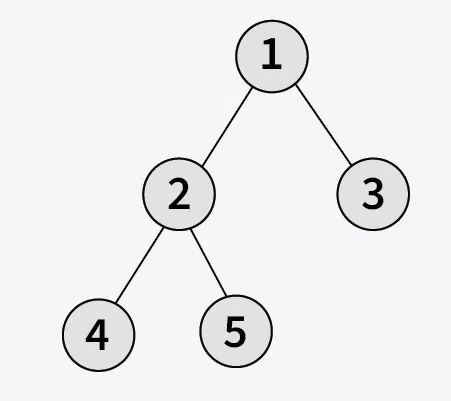
Input:root[] = [1, 2, 3, 4, 5, N, N]
Output:[[1, 2, 4], [1, 2, 5], [1, 3]]
Explanation:All the possible paths from root node to leaf nodes are: 1 -> 2 -> 4, 1 -> 2 -> 5 and 1 -> 3
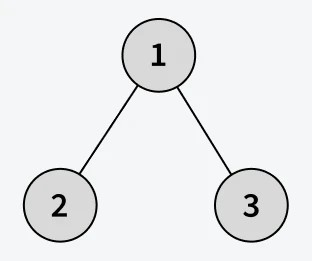
Input:root[] = [1, 2, 3]

Output:[[1, 2], [1, 3]]
Explanation:All the possible paths from root node to leaf nodes are: 1 -> 2 and 1 -> 3
-
Example:
✅ Solution: DFS with Backtracking
class Solution {
  public:
    // Helper function to collect all root-to-leaf paths
    void solve(Node *currentNode, vector<int> currentPath, vector<vector<int>> &allPaths){
        if(currentNode == NULL) return;  // Base case: null node

        currentPath.push_back(currentNode->data); // Add current node to path

        // If it's a leaf node, store the complete path
        if(currentNode->left == NULL && currentNode->right == NULL){
            allPaths.push_back(currentPath);
            return;
        }

        // Recurse to the left and right subtree
        solve(currentNode->left, currentPath, allPaths);
        solve(currentNode->right, currentPath, allPaths);
    }

    // Main function to return all root-to-leaf paths
    vector<vector<int>> Paths(Node* root) {
        vector<vector<int>> allPaths;     // Stores all the resulting paths
        vector<int> currentPath;          // Tracks current traversal path

        solve(root, currentPath, allPaths);
        return allPaths;
    }
};
📝 How It Works
- Performs a recursive depth-first traversal of the binary tree.
- Maintains a
currentPathlist that accumulates the nodes on the path from root to current node. - On reaching a leaf node, the path is stored in
allPaths. - The recursion unwinds and backtracks to explore all root-to-leaf paths.
🧩 Key Concept
- Traverse from root to every leaf, recording each unique path.
- This is a standard DFS + backtracking pattern.
⏱️ Time & Space Complexity
| Metric | Complexity |
|---|---|
| Time | O(N) — Every node is visited once |
| Space | O(H) for recursion stack, plus O(P × L) for storing paths |
N: number of nodesH: height of the treeP: number of paths (leaf nodes)L: average length of a path
⚠️ Edge Cases
- Tree is empty → returns an empty list.
- Tree has only one node → returns a single path with that node.
- Skewed trees → still correctly records paths.
💡 Other Approaches
| Approach | Time | Space |
|---|---|---|
| DFS + backtracking (this) ✅ | O(N) | O(H) |
| BFS (level-order path build) | O(N) | O(N) — more space-heavy |
🔁 Related Problems
💬