Bridge in a Graph
Problem Statement:
There are n servers numbered from 0 to n - 1 connected by undirected server-to-server connections forming a network where connections[i] = [ai, bi] represents a connection between servers ai and bi. Any server can reach other servers directly or indirectly through the network.
A critical connection is a connection that, if removed, will make some servers unable to reach some other server.
Return all critical connections in the network in any order.
-
Example:
Example 1:
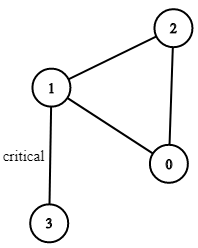
Input: n = 4, connections = [[0,1],[1,2],[2,0],[1,3]]
Output: [[1,3]]
Explanation: [[3,1]] is also accepted.
Example 2:
Input: n = 2, connections = [[0,1]]
Output: [[0,1]]
✅ Solution: DFS + Tarjan’s Algorithm
class Solution {
public:
    void dfs(int node, int parent, vector<vector<int>> &adjList, vector<bool> &vis,
             vector<vector<int>> &bridges, int &timer, vector<int> &low, vector<int> &tin) {

        vis[node] = true;
        tin[node] = low[node] = timer++;

        for(auto neighbor : adjList[node]) {
            if(neighbor == parent) continue; // Skip the parent edge

            if(!vis[neighbor]) {
                dfs(neighbor, node, adjList, vis, bridges, timer, low, tin);

                // After visiting neighbor, update low-link value
                low[node] = min(low[node], low[neighbor]);

                // Check for bridge condition
                if(low[neighbor] > tin[node]) {
                    bridges.push_back({node, neighbor});
                }
            } else {
                // Back-edge case
                low[node] = min(low[node], tin[neighbor]);
            }
        }
    }

    vector<vector<int>> criticalConnections(int n, vector<vector<int>>& connections) {
        vector<vector<int>> adjList(n);
        for(auto conn : connections){
            adjList[conn[0]].push_back(conn[1]);
            adjList[conn[1]].push_back(conn[0]);
        }

        int timer = 1;
        vector<bool> vis(n, false);
        vector<int> low(n), tin(n);
        vector<vector<int>> bridges;

        // For disconnected components (though in this problem graph is connected)
        for(int i = 0; i < n; i++) {
            if(!vis[i]) {
                dfs(i, -1, adjList, vis, bridges, timer, low, tin);
            }
        }

        return bridges;
    }
};
📝 How It Works
- We use Tarjan’s algorithm to find bridges (aka critical connections).
- A bridge is an edge
(u, v)such that removing it increases the number of connected components. - We do a DFS traversal and track:
tin[node]: time of insertion into DFS treelow[node]: lowest discovery time reachable from subtree rooted at node
- If
low[neighbor] > tin[node], then(node, neighbor)is a bridge.
🧩 Key Formula / Condition
-
Bridge condition:
if (low[neigh] > tin[node])
    (node, neigh) is a bridge
⏱️ Time & Space Complexity
| Metric | Value |
|---|---|
| ⏱️ Time | O(N + E) — DFS traversal |
| 💾 Space | O(N + E) — adjacency list + tin/low arrays |
⚠️ Edge Cases
- Disconnected graph: the code handles it via loop on all
i. - Multiple components or a tree: still works.
💡 Other Approaches
| Approach | Time |
|---|---|
| Remove each edge and check connectivity | O(E * (N + E)) ❌ |
| Tarjan’s Algorithm ✅ | O(N + E) |
🔁 Related Problems
- Leetcode 1192: Critical Connections in a Network ✅
- Articulation Points in Graph
- Strongly Connected Components (Tarjan / Kosaraju)
- Bridge Tree Construction
💬