Cheapest flight with K Stops
Problem Statement:
There are n cities connected by some number of flights. You are given an array flights where flights[i] = [fromi, toi, pricei] indicates that there is a flight from city fromi to city toi with cost pricei.
You are also given three integers src, dst, and k, return the cheapest price from src to dst with at most k stops. If there is no such route, return **-1.
-
Example:
Example 1:
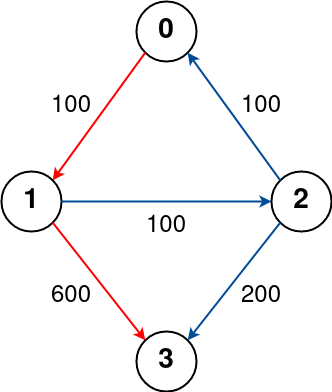
Input: n = 4, flights = [[0,1,100],[1,2,100],[2,0,100],[1,3,600],[2,3,200]], src = 0, dst = 3, k = 1
Output: 700
Explanation:
The graph is shown above.
The optimal path with at most 1 stop from city 0 to 3 is marked in red and has cost 100 + 600 = 700.
Note that the path through cities [0,1,2,3] is cheaper but is invalid because it uses 2 stops.
Example 2:
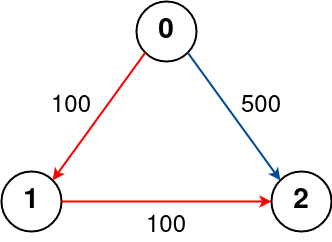
Input: n = 3, flights = [[0,1,100],[1,2,100],[0,2,500]], src = 0, dst = 2, k = 1
Output: 200
Explanation:
The graph is shown above.
The optimal path with at most 1 stop from city 0 to 2 is marked in red and has cost 100 + 100 = 200.
Example 3:
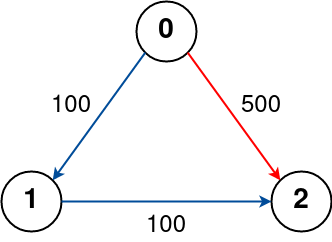
Input: n = 3, flights = [[0,1,100],[1,2,100],[0,2,500]], src = 0, dst = 2, k = 0
Output: 500
Explanation:
The graph is shown above.
The optimal path with no stops from city 0 to 2 is marked in red and has cost 500.
✅ Solution: Modified BFS (Dijkstra with Stop Constraint)
class Solution {
public:
    int findCheapestPrice(int n, vector<vector<int>>& flights, int src, int dst, int k) {
        // Build adjacency list: node → list of {neighbor, cost}
        vector<vector<pair<int, int>>> adjList(n);
        for (auto flight : flights) {
            int u = flight[0], v = flight[1], cost = flight[2];
            adjList[u].push_back({v, cost});
        }

        // Queue format: {stops, {currentCity, totalCost}}
        queue<pair<int, pair<int, int>>> bfsQueue;
        bfsQueue.push({0, {src, 0}});

        // Distance array to track minimum cost to each city
        vector<int> minCost(n, 1e9);
        minCost[src] = 0;

        while (!bfsQueue.empty()) {
            auto front = bfsQueue.front();
            bfsQueue.pop();

            int stops = front.first;
            int currCity = front.second.first;
            int costSoFar = front.second.second;

            if (stops > k) continue;  // Exceeded stop limit

            // Check neighbors
            for (auto neighbor : adjList[currCity]) {
                int nextCity = neighbor.first;
                int price = neighbor.second;

                int newCost = costSoFar + price;
                if (newCost < minCost[nextCity] && stops <= k) {
                    minCost[nextCity] = newCost;
                    bfsQueue.push({stops + 1, {nextCity, newCost}});
                }
            }
        }

        return minCost[dst] == 1e9 ? -1 : minCost[dst];
    }
};
📝 How It Works
- You need to find the minimum cost from
srctodstusing at most k stops. - Treat the flight network as a graph, where edges are flights and weights are costs.
- Use a modified BFS (similar to Dijkstra) that also tracks the number of stops.
- For each node, if you find a cheaper path within the allowed
k + 1edges, update and push it to the queue.
🧩 Key Concept
Each queue element stores:
stops: how many flights taken so farcurrentCity: current nodecostSoFar: total cost to reach that city
We only process paths with stops ≤ k.
⏱️ Time & Space Complexity
| Metric | Complexity |
|---|---|
| Time | O(N + E·K) |
| Space | O(N + E) |
- In the worst case, each edge is traversed for every level up to
k. - Works better in practice with pruning using the distance array.
⚠️ Edge Cases
- If no path exists within
kstops → return1. - If
src == dst→ cost is0. - Multiple flights between same cities with different costs.
💡 Other Approaches
| Approach | Time | Notes |
|---|---|---|
| Bellman-Ford (k+1 passes) | O(k·E) | Classic method for k-constrained paths |
| Dijkstra (with stops) | O(E log V) | Use min-heap & stops as a state |
| BFS with queue ✅ | O(N + E·K) | Clean and intuitive |
🔁 Related Problems
- LC 787. Cheapest Flights Within K Stops
- LC 743. Network Delay Time
- LC 1631. Path with Minimum Effort
- LC 847. Shortest Path Visiting All Nodes
🛠️ Other Notes
- This is a great example of BFS with additional state tracking (
stops). - You can also implement this using a priority queue (min-heap) to explore cheaper routes first.
- Use Bellman-Ford if you’re asked to explore all paths up to
kedges globally.
💬