Find Eventual Safe Nodes
Problem Statement:
There is a directed graph of n nodes with each node labeled from 0 to n - 1. The graph is represented by a 0-indexed 2D integer array graph where graph[i] is an integer array of nodes adjacent to node i, meaning there is an edge from node i to each node in graph[i].
A node is a terminal node if there are no outgoing edges. A node is a safe node if every possible path starting from that node leads to a terminal node (or another safe node).
Return an array containing all the safe nodes of the graph. The answer should be sorted in ascending order.
Example 1:
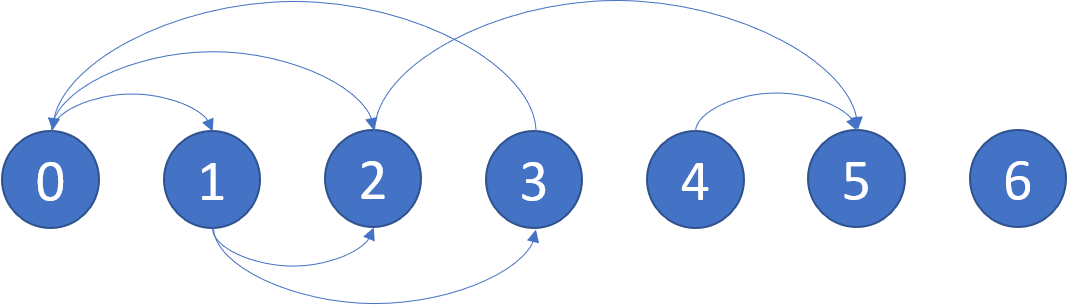
Input: graph = [[1,2],[2,3],[5],[0],[5],[],[]]
Output: [2,4,5,6]
Explanation: The given graph is shown above.
Nodes 5 and 6 are terminal nodes as there are no outgoing edges from either of them.
Every path starting at nodes 2, 4, 5, and 6 all lead to either node 5 or 6.
Example 2:
Input: graph = [[1,2,3,4],[1,2],[3,4],[0,4],[]]
Output: [4]
Explanation:
Only node 4 is a terminal node, and every path starting at node 4 leads to node 4.
-
Example:
✅ Solution: Reverse Graph + Kahn’s Algorithm — Eventual Safe States (Topological Sort Approach)
✅ Solution Code
class Solution {
public:
    vector<int> eventualSafeNodes(vector<vector<int>>& graph) {
        int v = graph.size();
        vector<vector<int>> revGraph(v);
        vector<int> inDeg(v, 0);

        // Build reverse graph and count in-degrees
        for (int i = 0; i < v; i++) {
            for (auto neighbor : graph[i]) {
                revGraph[neighbor].push_back(i);
                inDeg[i]++;
            }
        }

        queue<int> q;
        for (int i = 0; i < v; i++) {
            if (inDeg[i] == 0) {
                q.push(i);
            }
        }

        vector<int> safeNodes;
        while (!q.empty()) {
            int node = q.front();
            q.pop();
            safeNodes.push_back(node);

            for (auto neighbor : revGraph[node]) {
                if (--inDeg[neighbor] == 0) {
                    q.push(neighbor);
                }
            }
        }

        sort(safeNodes.begin(), safeNodes.end());
        return safeNodes;
    }
};
📝 How It Works
-
Objective: Return all nodes where every path from that node eventually leads to a terminal node (no cycles).
-
Technique:
Use reverse graph + in-degree count (Kahn’s Algorithm):
- Reverse all edges: Instead of
u → v, makev → u. - Process nodes with in-degree 0 (terminal nodes in the original graph).
- Remove nodes as we process them, identifying all nodes that do not participate in cycles.
- Reverse all edges: Instead of
-
Step-by-Step:
- Build a reverse graph.
- Count in-degrees for each node in the original graph.
- Apply BFS to nodes with in-degree 0 in the reversed graph.
- Collected nodes are the safe nodes.
🧩 Key Formula / Recurrence
-
Reverse graph construction:
revGraph[neighbor].push_back(i);
inDeg[i]++; -
BFS traversal:
while (!q.empty()):
    for (neighbor in revGraph[node]):
        inDeg[neighbor]--;
        if (inDeg[neighbor] == 0):
            q.push(neighbor);
⏱️ Time & Space Complexity
| Metric | Value |
|---|---|
| Time Complexity | O(V + E) |
| Space Complexity | O(V + E) |
Where:
- V = number of nodes.
- E = number of edges.
⚠️ Edge Cases
- Empty graph → Return empty list.
- Graph with all terminal nodes → Return all nodes.
- Graph with cycles → Nodes involved in cycles are not in the result.
💡 Other Approaches
| Approach | Time Complexity | Notes |
|---|---|---|
| DFS with Coloring | O(V + E) | Uses visited + recursion stack coloring. |
🔁 Related Problems
- LeetCode 802: Find Eventual Safe States (Exact Problem)
- LeetCode 207: Course Schedule
- LeetCode 210: Course Schedule II
- LeetCode 785: Is Graph Bipartite?
🛠️ Other Notes
-
✅ Real-World Analogy:
In a workflow system, identifying tasks that can always finish without getting stuck in a loop.
-
✅ Reverse graph + Kahn’s Algorithm is a reliable and intuitive method for detecting safe states and cycle-free nodes in directed graphs.
-
✅ Safe nodes are always part of the graph's Directed Acyclic Graph (DAG) components.