Find the City With the Smallest Number of Neighbors at a Threshold Distance
Problem Statement:
There are n cities numbered from 0 to n-1. Given the array edges where edges[i] = [fromi, toi, weighti] represents a bidirectional and weighted edge between cities fromi and toi, and given the integer distanceThreshold.
Return the city with the smallest number of cities that are reachable through some path and whose distance is at most distanceThreshold, If there are multiple such cities, return the city with the greatest number.
Notice that the distance of a path connecting cities i and j is equal to the sum of the edges' weights along that path.
-
Example:
Example 1:
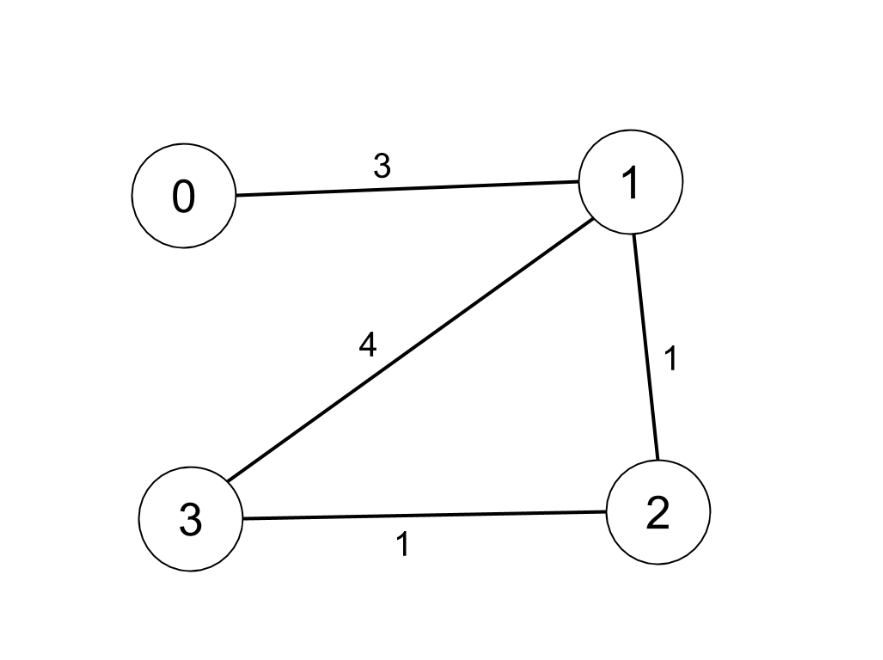
Input: n = 4, edges = [[0,1,3],[1,2,1],[1,3,4],[2,3,1]], distanceThreshold = 4
Output: 3
Explanation:The figure above describes the graph.
The neighboring cities at a distanceThreshold = 4 for each city are:
City 0 -> [City 1, City 2]
City 1 -> [City 0, City 2, City 3]
City 2 -> [City 0, City 1, City 3]
City 3 -> [City 1, City 2]
Cities 0 and 3 have 2 neighboring cities at a distanceThreshold = 4, but we have to return city 3 since it has the greatest number.
Example 2:
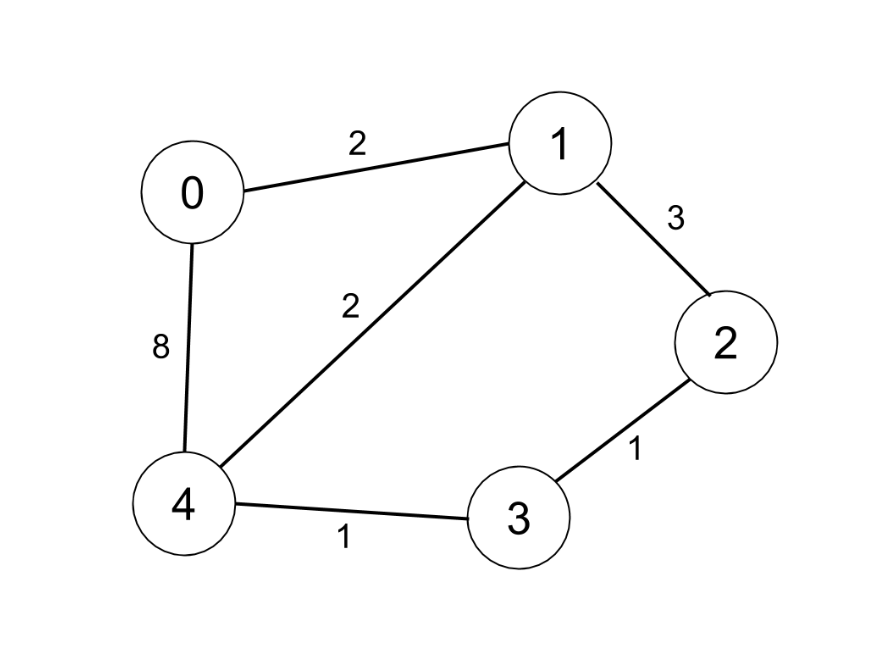
Input: n = 5, edges = [[0,1,2],[0,4,8],[1,2,3],[1,4,2],[2,3,1],[3,4,1]], distanceThreshold = 2
Output: 0
Explanation:The figure above describes the graph.
The neighboring cities at a distanceThreshold = 2 for each city are:
City 0 -> [City 1]
City 1 -> [City 0, City 4]
City 2 -> [City 3, City 4]
City 3 -> [City 2, City 4]
City 4 -> [City 1, City 2, City 3]
The city 0 has 1 neighboring city at a distanceThreshold = 2.
✅ Solution: Floyd-Warshall
class Solution {
public:
    int findTheCity(int n, vector<vector<int>>& edges, int distanceThreshold) {
        // Initialize distance matrix with INT_MAX
        vector<vector<int>> dist(n, vector<int>(n, INT_MAX));

        // Fill direct edges
        for(auto it : edges){
            dist[it[0]][it[1]] = it[2];
            dist[it[1]][it[0]] = it[2];
        }

        // Distance from a city to itself is 0
        for(int i = 0; i < n; i++) dist[i][i] = 0;

        // Floyd-Warshall to compute all-pairs shortest paths
        for(int k = 0; k < n; k++){
            for(int i = 0; i < n; i++){
                for(int j = 0; j < n; j++){
                    // Skip if path doesn't exist to avoid overflow
                    if(dist[i][k] == INT_MAX || dist[k][j] == INT_MAX) continue;

                    // Update shortest distance
                    dist[i][j] = min(dist[i][j], dist[i][k] + dist[k][j]);
                }
            }
        }

        int minReachable = n;  // Max possible count
        int cityNo = -1;

        // Find the city with minimum reachable neighbors within the threshold
        for(int i = 0; i < n; i++){
            int count = 0;
            for(int j = 0; j < n; j++){
                if(dist[i][j] <= distanceThreshold){
                    count++;
                }
            }

            // If count is same, prefer the city with larger number (as per question)
            if(count <= minReachable){
                minReachable = count;
                cityNo = i;
            }
        }

        return cityNo;
    }
};
📝 How It Works
- Build a distance matrix to represent graph using edge weights.
- Use Floyd-Warshall algorithm to compute the shortest paths between all pairs.
- For each city, count how many other cities are reachable within the
distanceThreshold. - Track the city with the smallest number of reachable cities. If multiple cities have the same count, pick the one with the largest index.
🧩 Key Formula / Transition
⏱️ Time & Space Complexity
| Metric | Complexity |
|---|---|
| Time | O(N³) |
| Space | O(N²) |
Nis the number of cities.
⚠️ Edge Cases
- Multiple cities with same reachable count → return maximum index city.
- Distance overflow: Guard against
INT_MAX + distby checking before addition. - Self-distances must be initialized to
0.
💡 Other Approaches
| Approach | Time | Notes |
|---|---|---|
| Dijkstra from each city | O(N * E log N) | Better for sparse graphs, but harder to implement for all-pairs. |
| Floyd-Warshall | O(N³) | Simple and works well for dense graphs. |
🔁 Related Problems
- Leetcode 1334 - Find the City With the Smallest Number of Neighbors
- Leetcode 743 - Network Delay Time
- Leetcode 787 - Cheapest Flights Within K Stops
🛠️ Other Notes
- This problem is a graph analysis task that checks centrality based on reachability.
- Floyd-Warshall gives a clean and direct method for all-pair shortest path problems like this.
- Good fit when
n <= 100due to cubic complexity.
💬