Flloyd Warshall
Problem Statement:
You are given an weighted directed graph, represented by an adjacency matrix, dist[][] of size n x n, where dist[i][j] represents the weight of the edge from node i to node j. If there is no direct edge, dist[i][j] is set to a large value (i.e., 108) to represent infinity.
The graph may contain negative edge weights, but it does not contain any negative weight cycles.
Your task is to find the shortest distance between every pair of nodes i and j in the graph.
Note: Modify the distances for every pair in place.
-
Example:
Examples :
Input:dist[][] = [[0, 4, 108, 5, 108], [108, 0, 1, 108, 6], [2, 108, 0, 3, 108], [108, 108, 1, 0, 2], [1, 108, 108, 4, 0]]

Output:[[0, 4, 5, 5, 7], [3, 0, 1, 4, 6], [2, 6, 0, 3, 5], [3, 7, 1, 0, 2], [1, 5, 5, 4, 0]]

Explanation:Each cell dist[i][j] in the output shows the shortest distance from node i to node j, computed by considering all possible intermediate nodes.

Input:dist[][] = [[0, -1, 2], [1, 0, 108], [3, 1, 0]]

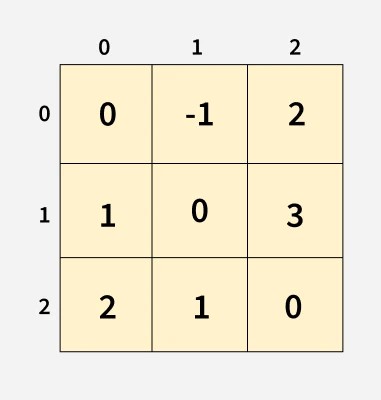
Output:[[0, -1, 2], [1, 0, 3], [2, 1, 0]]

Explanation:Each cell dist[i][j] in the output shows the shortest distance from node i to node j, computed by considering all possible intermediate nodes.
From 2 to 0 shortest distance should be 2 by following path 2 -> 1 -> 0
From 1 to 2 shortest distance should be 3 by following path 1 -> 0 -> 2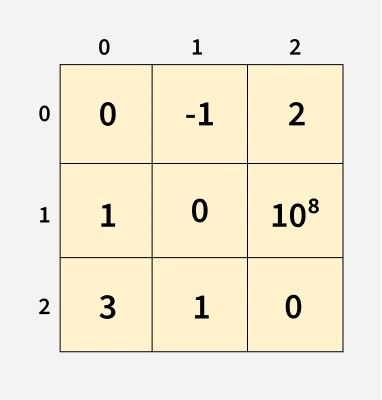
✅ Solution: Floyd-Warshall (All Pairs Shortest Path)
class Solution {
  public:
    void floydWarshall(vector<vector<int>> &dist) {
        int n = dist.size();
        for(int k = 0; k < n; k++){
            for(int i = 0; i < n; i++){
                for(int j = 0; j < n; j++){
                    // Only proceed if both paths are valid (not INF)
                    if (dist[i][k] < 1e8 && dist[k][j] < 1e8) {
                        dist[i][j] = min(dist[i][j], dist[i][k] + dist[k][j]);
                    }
                }
            }
        }
    }
};
📝 How It Works
- The algorithm considers each node
kas an intermediate point and checks if going from nodei → jviakoffers a shorter path. - This is done for all pairs
(i, j)for each possible intermediate nodek. - The matrix
dist[i][j]is updated in-place to store the shortest distance from nodeitoj.
🧩 Key Formula / Transition
- Applied for every triple
(i, j, k).
⏱️ Time & Space Complexity
| Metric | Complexity |
|---|---|
| Time | O(N³) |
| Space | O(1) extra |
- Works in-place if the input matrix is directly modified.
⚠️ Edge Cases
- Ensure no integer overflow happens when dummy values like
1e8are used to represent infinity. Checkdist[i][k] < 1e8before adding. - If graph has negative cycles, additional logic can be added to detect it (
dist[i][i] < 0after completion). - Input may contain
1e8orINT_MAXto represent no path — ensure proper guards to avoid overflow.
💡 Other Approaches
| Approach | Use Case | Time |
|---|---|---|
| Dijkstra N times | Works for positive weights only | O(N × E log N) |
| Floyd-Warshall | Handles all pairs, even with negative edges | O(N³) |
🔁 Related Problems
- Leetcode 1334 – Find the City With the Smallest Number of Neighbors
- GFG – Floyd Warshall
- Shortest cycle in a directed graph
- Detecting negative weight cycles
🛠️ Other Notes
- Real-world analogy: Floyd-Warshall is like building a map of all shortest air routes between all cities.
- You can use this to compute the transitive closure by replacing the weight matrix with boolean reachability matrix.
- The algorithm is simple, but not suitable for large graphs due to its cubic time complexity.
💬