Number of Enclave
Problem Statement:
You are given an m x n binary matrix grid, where 0 represents a sea cell and 1 represents a land cell.
A move consists of walking from one land cell to another adjacent (4-directionally) land cell or walking off the boundary of the grid.
Return the number of land cells in grid for which we cannot walk off the boundary of the grid in any number of moves.
Example 1:
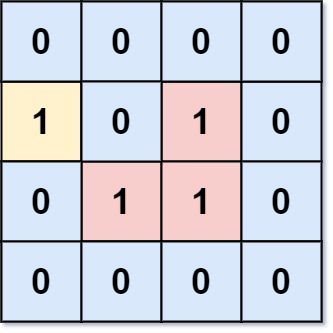
Input: grid = [[0,0,0,0],[1,0,1,0],[0,1,1,0],[0,0,0,0]]
Output: 3
Explanation: There are three 1s that are enclosed by 0s, and one 1 that is not enclosed because its on the boundary.
Example 2:
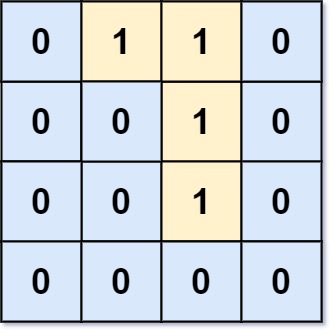
Input: grid = [[0,1,1,0],[0,0,1,0],[0,0,1,0],[0,0,0,0]]
Output: 0
Explanation: All 1s are either on the boundary or can reach the boundary.
-
Example:
✅ Solution: DFS (Depth-First Search)
class Solution {
public:
    // DFS function to mark all reachable land cells from boundary
    void dfs(int x, int y, int n, int m, vector<vector<int>> &visited, int dx[], int dy[],
             vector<vector<int>>& grid) {
        visited[x][y] = 1;

        for (int i = 0; i < 4; i++) {
            int newX = x + dx[i];
            int newY = y + dy[i];

            // Explore valid neighbors with land (grid value 1) that are unvisited
            if (newX >= 0 && newX < n && newY >= 0 && newY < m &&
                visited[newX][newY] == 0 && grid[newX][newY] == 1) {
                dfs(newX, newY, n, m, visited, dx, dy, grid);
            }
        }
    }

    int numEnclaves(vector<vector<int>>& grid) {
        int n = grid.size();
        int m = grid[0].size();

        vector<vector<int>> visited(n, vector<int>(m, 0));
        int dx[4] = {0, 0, 1, -1};
        int dy[4] = {1, -1, 0, 0};

        // Mark all land cells connected to boundary using DFS
        for (int j = 0; j < m; j++) {
            if (!visited[0][j] && grid[0][j] == 1) {
                dfs(0, j, n, m, visited, dx, dy, grid);
            }
            if (!visited[n - 1][j] && grid[n - 1][j] == 1) {
                dfs(n - 1, j, n, m, visited, dx, dy, grid);
            }
        }

        for (int i = 0; i < n; i++) {
            if (!visited[i][0] && grid[i][0] == 1) {
                dfs(i, 0, n, m, visited, dx, dy, grid);
            }
            if (!visited[i][m - 1] && grid[i][m - 1] == 1) {
                dfs(i, m - 1, n, m, visited, dx, dy, grid);
            }
        }

        // Count all land cells not connected to boundary
        int count = 0;
        for (int i = 0; i < n; i++) {
            for (int j = 0; j < m; j++) {
                if (!visited[i][j] && grid[i][j] == 1) {
                    count++;
                }
            }
        }

        return count;
    }
};
📝 How It Works
-
Problem Goal: Count the number of land cells (
1s) that cannot reach the boundary (i.e., are enclosed). -
Approach:
- Perform DFS from all land cells on the boundary to mark them as visited.
- Traverse the entire grid. Count all unvisited land cells — these are the enclaves.
-
Why It Works:
By marking all reachable land cells from the boundary, we exclude non-enclaved cells from the count.
🧩 Key Formula / Recurrence
-
Recurrence relation:
dfs(x, y) = dfs(x+1, y) + dfs(x-1, y) + dfs(x, y+1) + dfs(x, y-1) -
No tabulation or DP — pure DFS flood fill.
⏱️ Time & Space Complexity
| Complexity | Value |
|---|---|
| Time | O(N × M) — Each cell is visited at most once. |
| Space | O(N × M) — For visited matrix and recursion stack. |
⚠️ Edge Cases
- All cells are
0: Should return0. - All land cells (
1) are on the boundary: Should return0. - Single row or single column grid: Special cases where there’s no enclosed land.
💡 Other Approaches
- BFS using queue instead of DFS — Similar complexity.
- Union-Find (DSU) — More complex to set up but solves the problem without explicit DFS/BFS.
- In-place grid marking — If memory optimization is required, use grid value modification (e.g., mark visited land cells as
2instead of using a separate visited matrix).
🔁 Related Problems
- LeetCode 1020: Number of Enclaves (exact same problem)
- LeetCode 1254: Number of Closed Islands
- LeetCode 200: Number of Islands
- LeetCode 695: Max Area of Island
🛠️ Other Notes
- ✅ Important: Avoid passing grid or visited arrays by value in recursive DFS calls. Always use references to avoid unnecessary copying and TLE.
- ✅ This type of grid flood fill is also common in image processing tasks like boundary detection or shape detection.
💬