Number of Operations to Make Network Connected
Problem Statement:
There are n computers numbered from 0 to n - 1 connected by ethernet cables connections forming a network where connections[i] = [ai, bi] represents a connection between computers ai and bi. Any computer can reach any other computer directly or indirectly through the network.
You are given an initial computer network connections. You can extract certain cables between two directly connected computers, and place them between any pair of disconnected computers to make them directly connected.
Return the minimum number of times you need to do this in order to make all the computers connected. If it is not possible, return -1.
-
Example:
Example 1:
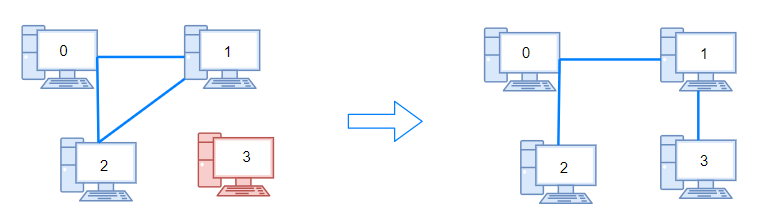
Input: n = 4, connections = [[0,1],[0,2],[1,2]]
Output: 1
Explanation: Remove cable between computer 1 and 2 and place between computers 1 and 3.
Example 2:
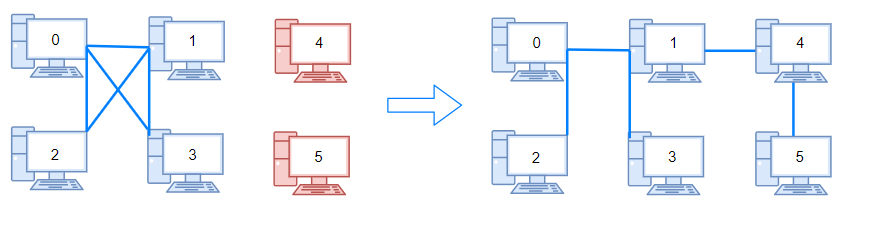
Input: n = 6, connections = [[0,1],[0,2],[0,3],[1,2],[1,3]]
Output: 2
Example 3:
Input: n = 6, connections = [[0,1],[0,2],[0,3],[1,2]]
Output: -1
Explanation: There are not enough cables.
Solution: Disjoint Set (Union Find with Union by Size)
class DisjointSet {
public:
    vector<int> parent, rank, size;

    // Constructor to initialize parent, rank and size
    DisjointSet(int n){
        rank.resize(n + 1, 0);
        parent.resize(n + 1);
        size.resize(n + 1, 1);
        for(int i = 0; i <= n; i++){
            parent[i] = i; // each node is initially its own parent
        }
    }

    // Find with path compression
    int findParent(int x){
        if(parent[x] == x) return x;
        return parent[x] = findParent(parent[x]); // compress path
    }

    // Union by size
    void unionBySize(int y, int z){
        int rootY = findParent(y);
        int rootZ = findParent(z);

        if(rootY == rootZ) return;

        if(size[rootY] > size[rootZ]){
            parent[rootZ] = rootY;
            size[rootY] += size[rootZ];
        }
        else {
            parent[rootY] = rootZ;
            size[rootZ] += size[rootY];
        }
    }
};

class Solution {
public:
    int makeConnected(int n, vector<vector<int>>& connections) {
        DisjointSet ds(n);
        int cntExtras = 0; // count of redundant connections

        // Process each connection
        for(auto it : connections){
            int u = it[0];
            int v = it[1];

            // If both have same parent, it's an extra cable
            if(ds.findParent(u) == ds.findParent(v)){
                cntExtras++;
            } else {
                ds.unionBySize(u, v);
            }
        }

        // Count how many disconnected components exist
        int numComponents = 0;
        for(int i = 0; i < n; i++){
            if(ds.parent[i] == i) // i is representative of a component
                numComponents++;
        }

        int requiredCables = numComponents - 1;

        return (cntExtras >= requiredCables) ? requiredCables : -1;
    }
};
📝 How It Works
- The goal is to connect all
ncomputers using available cables. - We use Disjoint Set Union (DSU) to track how many connected components exist.
- For each connection:
- If both nodes are already in the same set → redundant cable (can be reused).
- Otherwise, unite them using union by size.
- After processing all connections:
- Count the number of disconnected components.
- To fully connect all components, we need (components - 1) extra cables.
- If the number of redundant cables is sufficient → return that count.
- Else → return
1(not enough cables to connect the network).
🧩 Key Formula / Recurrence
required_cables = components - 1- Use
unionBySize()to keep DSU trees flat and optimized. - Use
findParent()with path compression to avoid TLE.
⏱️ Time & Space Complexity
| Complexity | Value |
|---|---|
| ⏱️ Time | O(N + E*α(N)) where α(N) is inverse Ackermann function (nearly constant) |
| 💾 Space | O(N) for parent, rank, size arrays |
⚠️ Edge Cases
- Less than
n - 1total connections: return1immediately. - All nodes already connected: should return
0.
💡 Other Approaches
| Approach | Time | Notes |
|---|---|---|
| DFS/BFS | O(N + E) | Valid, but DSU is more optimal for repeated merging |
| Kruskal's (MST) | O(E log E) | Overkill for just checking connectivity |
🔁 Related Problems
- Leetcode 547: Number of Provinces (Connected Components in Graph)
- Leetcode 1319: Number of Operations to Make Network Connected ✅
- Leetcode 684: Redundant Connection
- GFG: Detect Cycle in Undirected Graph using DSU
🛠️ Other Notes
- Think of computers as islands, and cables as bridges.
- If you can reuse extra bridges (redundant cables), you can connect disconnected islands (components).
💬