Swim in Rising Water
Problem Statement:
You are given an n x n integer matrix grid where each value grid[i][j] represents the elevation at that point (i, j).
It starts raining, and water gradually rises over time. At time t, the water level is t, meaning any cell with elevation less than equal to t is submerged or reachable.
You can swim from a square to another 4-directionally adjacent square if and only if the elevation of both squares individually are at most t. You can swim infinite distances in zero time. Of course, you must stay within the boundaries of the grid during your swim.
Return the minimum time until you can reach the bottom right square (n - 1, n - 1) if you start at the top left square (0, 0).
-
Example:
Example 1:
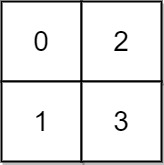
Input: grid = [[0,2],[1,3]]
Output: 3
Explanation:
At time 0, you are in grid location (0, 0).
You cannot go anywhere else because 4-directionally adjacent neighbors have a higher elevation than t = 0.
You cannot reach point (1, 1) until time 3.
When the depth of water is 3, we can swim anywhere inside the grid.
Example 2:
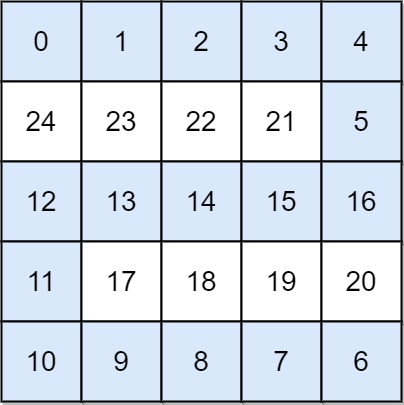
Input: grid = [[0,1,2,3,4],[24,23,22,21,5],[12,13,14,15,16],[11,17,18,19,20],[10,9,8,7,6]]
Output: 16
Explanation: The final route is shown.
We need to wait until time 16 so that (0, 0) and (4, 4) are connected.
✅ Solution: Dijkstra's Algorithm (Min-Heap Based Path Expansion)
class Solution {
public:
    int swimInWater(vector<vector<int>>& grid) {
        int n = grid.size();

        // visited matrix to avoid revisiting cells
        vector<vector<int>> visited(n, vector<int>(n, 0));

        // Min-heap: {time to reach cell, {row, col}}
        priority_queue<pair<int, pair<int, int>>,
                       vector<pair<int, pair<int, int>>>,
                       greater<>> pq;

        // Start from top-left corner with initial elevation
        pq.push({grid[0][0], {0, 0}});
        visited[0][0] = 1;

        // Direction vectors: right, left, down, up
        int dx[] = {0, 0, 1, -1};
        int dy[] = {1, -1, 0, 0};

        while(!pq.empty()){
            auto it = pq.top(); // get the cell with the lowest required time
            pq.pop();

            int currentTime = it.first;
            int x = it.second.first;
            int y = it.second.second;

            // If we reached bottom-right, return time
            if(x == n - 1 && y == n - 1) return currentTime;

            // Explore 4 adjacent directions
            for(int k = 0; k < 4; k++){
                int newX = x + dx[k];
                int newY = y + dy[k];

                // Check bounds and if not visited
                if(newX >= 0 && newY >= 0 && newX < n && newY < n && visited[newX][newY] == 0){
                    visited[newX][newY] = 1;

                    // Push the cell with max time seen so far
                    pq.push({max(currentTime, grid[newX][newY]), {newX, newY}});
                }
            }
        }

        return -1; // fallback, not expected to hit
    }
};
📝 How It Works
- This problem is a variation of Dijkstra's Algorithm.
- You can only move to neighboring cells if your current time is ≥ elevation of that cell.
- So we use a min-heap to always expand the cell with the least elevation/time required.
- Each move chooses the path with the minimum "maximum elevation" encountered.
🧩 Key Idea
- Use a priority queue to simulate water rising.
- Track the max elevation encountered on the path — it becomes your required time.
- As soon as the bottom-right is reached, return the time.
⏱️ Time & Space Complexity
| Metric | Value |
|---|---|
| ⏱️ Time | O(N^2 * log N^2) (each cell pushed once in heap) |
| 💾 Space | O(N^2) for visited and heap |
⚠️ Edge Cases
- Already sorted path → answer is grid[n-1][n-1].
- Max elevation is at the end → must take detours till time catches up.
🔁 Related Problems
- Leetcode 778: Swim in Rising Water ✅
- Leetcode 1631: Path with Minimum Effort
- Leetcode 743: Network Delay Time
- Leetcode 407: Trapping Rain Water II
💬