Bipartite Graph
Problem Statement:
There is an undirected graph with n nodes, where each node is numbered between 0 and n - 1. You are given a 2D array graph, where graph[u] is an array of nodes that node u is adjacent to. More formally, for each v in graph[u], there is an undirected edge between node u and node v. The graph has the following properties:
- There are no self-edges (
graph[u]does not containu). - There are no parallel edges (
graph[u]does not contain duplicate values). - If
vis ingraph[u], thenuis ingraph[v](the graph is undirected). - The graph may not be connected, meaning there may be two nodes
uandvsuch that there is no path between them.
A graph is bipartite if the nodes can be partitioned into two independent sets A and B such that every edge in the graph connects a node in set A and a node in set B.
Return true if and only if it is bipartite.
Example 1:
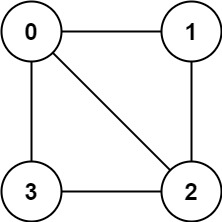
Input: graph = [[1,2,3],[0,2],[0,1,3],[0,2]]
Output: false
Explanation: There is no way to partition the nodes into two independent sets such that every edge connects a node in one and a node in the other.
Example 2:

Input: graph = [[1,3],[0,2],[1,3],[0,2]]
Output: true
Explanation: We can partition the nodes into two sets: {0, 2} and {1, 3}.
-
Example:
✅ Solution: DFS Coloring — Check if Graph is Bipartite
class Solution {
public:
    bool dfs(int node, int col, vector<int> &color, vector<vector<int>> &graph) {
        color[node] = col;

        for (auto neighbor : graph[node]) {
            if (color[neighbor] == -1) {
                if (!dfs(neighbor, !col, color, graph)) return false;
            } else if (color[neighbor] == col) {
                return false;  // Conflict: same color as current node
            }
        }
        return true;
    }

    bool isBipartite(vector<vector<int>>& graph) {
        int n = graph.size();
        vector<int> color(n, -1);  // -1 = unvisited, 0 and 1 = two colors

        for (int i = 0; i < n; i++) {
            if (color[i] == -1) {
                if (!dfs(i, 0, color, graph)) return false;
            }
        }
        return true;
    }
};
📝 How It Works
- Goal: Check if the graph can be colored using 2 colors such that no two adjacent nodes have the same color.
- Approach:
- Use DFS to assign colors alternately.
- Maintain a
colorarray:1means unvisited,0and1are the two colors. - If a conflict is found during DFS (neighbor has same color as current), return false.
- Why It Works:
- A graph is bipartite if it contains no odd-length cycles.
- Alternating colors while traversing is equivalent to partitioning into two sets.
🧩 Key Formula
-
DFS coloring recurrence:
color[node] = col;
for (neighbor in graph[node]):
    if (color[neighbor] == -1):
        dfs(neighbor, !col)
    else if (color[neighbor] == col):
        return false;
⏱️ Time & Space Complexity
| Metric | Value |
|---|---|
| Time Complexity | O(V + E) |
| Space Complexity | O(V) |
- V = number of nodes
- E = number of edges
- Standard DFS traversal complexity.
⚠️ Edge Cases
- Empty graph → Considered bipartite.
- Disconnected graph → Must check all components.
- Complete bipartite graph → Valid bipartite.
- Graph with odd-length cycle → Not bipartite.
💡 Other Approaches
| Approach | Time Complexity | Notes |
|---|---|---|
| BFS Coloring | O(V + E) | Uses a queue instead of recursion. |
🔁 Related Problems
- LeetCode 785: Is Graph Bipartite? (Exact Problem)
- LeetCode 886: Possible Bipartition
- LeetCode 997: Find the Town Judge (Related via graph concepts)
🛠️ Other Notes
-
✅ Real-World Analogy:
Assigning two alternating tasks or shifts to people without conflict (e.g., team A vs. team B).
-
✅ Useful property in problems related to 2-coloring, partitioning, and scheduling.
-
✅ Works for both connected and disconnected graphs by looping through all nodes.