Cycle Detection in Directed Graph
Problem Statement:
Given a Directed Graph with V vertices (Numbered from 0 to V-1) and E edges, check whether it contains any cycle or not.The graph is represented as a 2D vector edges[][], where each entry edges[i] = [u, v] denotes an edge from verticex u to v.
Examples:
Input:V = 4, edges[][] = [[0, 1], [0, 2], [1, 2], [2, 0], [2, 3]]
Output: true
Explanation: The diagram clearly shows a cycle 0 → 2 → 0

Input:V = 4, edges[][] = [[0, 1], [0, 2], [1, 2], [2, 3]

Output: false
Explanation: no cycle in the graph
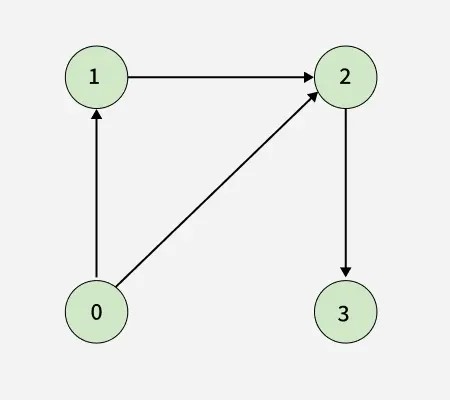
-
Example:
✅ Solution: DFS with Recursion Stack — Detect Cycle in Directed Graph
class Solution {
  public:
    bool dfs(int node, vector<bool> &visited, vector<bool> &recStack, vector<vector<int>> &adj) {
        visited[node] = true;
        recStack[node] = true;

        for (auto neighbor : adj[node]) {
            if (!visited[neighbor]) {
                if (dfs(neighbor, visited, recStack, adj)) return true;
            } else if (recStack[neighbor]) {
                return true;  // Cycle detected
            }
        }

        recStack[node] = false;
        return false;
    }

    bool isCyclic(int V, vector<vector<int>> &edges) {
        vector<bool> visited(V, false);
        vector<bool> recStack(V, false);
        vector<vector<int>> adj(V);

        for (auto &edge : edges) {
            adj[edge[0]].push_back(edge[1]);
        }

        for (int i = 0; i < V; i++) {
            if (!visited[i]) {
                if (dfs(i, visited, recStack, adj)) return true;
            }
        }

        return false;
    }
};
📝 How It Works
-
Objective: Detect if there is a cycle in a directed graph.
-
Technique:
Use DFS with a recursion stack (
recStackarray):visited[]tracks visited nodes overall.recStack[]tracks nodes in the current DFS call path.
-
Step-by-Step:
- Convert edge list to adjacency list.
- For each unvisited node:
- Run DFS.
- If we visit a node already in the current path (
recStack), it means there’s a cycle.
- If no cycles found after checking all nodes, return false.
-
Why This Works:
- Recursion stack ensures we only detect back edges specific to directed graphs.
🧩 Key Formula / Recurrence
DFS recurrence:
if (!visited[neighbor]) {
    dfs(neighbor, visited, recStack, adj)
} else if (recStack[neighbor]) {
    return true;  // Cycle found
}
⏱️ Time & Space Complexity
| Metric | Value |
|---|---|
| Time Complexity | O(V + E) |
| Space Complexity | O(V + E) |
- V = number of vertices
- E = number of edges
- Adjacency list + recursion stack + visited arrays.
⚠️ Edge Cases
- No edges → No cycle.
- Multiple components → Must check all.
- Self-loop → Immediate cycle.
💡 Other Approaches
| Approach | Time Complexity | Notes |
|---|---|---|
| Kahn’s Algorithm (BFS) | O(V + E) | Topological Sort check. Works for DAG cycle detection. |
🔁 Related Problems
- LeetCode 207: Course Schedule (Exact Problem)
- LeetCode 210: Course Schedule II
- LeetCode 2360: Longest Cycle in a Graph
🛠️ Other Notes
-
✅ Real-World Analogy:
Detecting circular dependencies in build systems or package management (e.g., npm/yarn dependency graphs).
-
✅ Works for disconnected graphs since we run DFS from all unvisited nodes.
-
✅ Self-loop and back-edge handling is automatic with
recStack.
💬