Cycle Detection in Undirected Graph (DFS)
Problem Statement:
Given an undirected graph with V vertices and E edges, represented as a 2D vector edges[][] , where each entry edges[i] = [u, v] denotes an edge between vertices u and v , determine whether the graph contains a cycle or not.
Examples:
Input:V = 4, E = 4, edges[][] = [[0, 1], [0, 2], [1, 2], [2, 3]]
Output:true
Explanation:
1 -> 2 -> 0 -> 1 is a cycle.
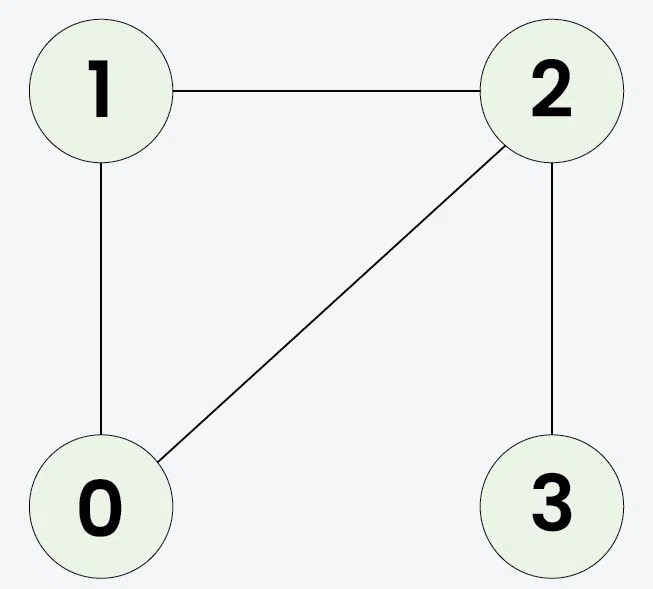
Input:V = 4, E = 3, edges[][] = [[0, 1], [1, 2], [2, 3]]
Output:false
Explanation:

No cycle in the graph.

-
Example:
✅ Solution: Detect Cycle in Undirected Graph Using DFS (With Parent Tracking)
// ✅ Cycle Detection in Undirected Graph Using DFS (C++) - Parent Tracking

class Solution {
  public:
    bool detect(int node, int parent, vector<bool>& visited, vector<vector<int>>& adj) {
        visited[node] = true;

        for (auto adjNode : adj[node]) {
            if (!visited[adjNode]) {
                if (detect(adjNode, node, visited, adj)) return true;
            }
            else if (adjNode != parent) {
                // If already visited and not the parent, it's a cycle
                return true;
            }
        }

        return false;
    }

    bool isCycle(int V, vector<vector<int>>& edges) {
        vector<vector<int>> adj(V);

        // Build adjacency list from edge list
        for (auto edge : edges) {
            adj[edge[0]].push_back(edge[1]);
            adj[edge[1]].push_back(edge[0]);
        }

        vector<bool> visited(V, false);

        // Check each component
        for (int i = 0; i < V; i++) {
            if (!visited[i]) {
                if (detect(i, -1, visited, adj)) return true;
            }
        }

        return false;
    }
};
📝 How It Works
- Step 1: Convert edge list to adjacency list.
- Step 2: Run DFS on each unvisited node:
- Mark node as visited.
- If an already visited neighbor is found that is not the parent, it’s a cycle.
- Step 3: If DFS finds any cycle, return true; otherwise false.
✅ It checks each connected component using standard DFS with parent check.
🧩 Key Formula / Recurrence
-
DFS Cycle Formula:
if (visited[adjNode] && adjNode != parent) → cycle exists
⏱️ Time & Space Complexity
| Metric | Value |
|---|---|
| Time | O(V + E) |
| Space | O(V + E) |
Where:
- V is number of vertices.
- E is number of edges.
⚠️ Edge Cases
- Self-loop → Cycle detected.
- Disconnected components → Handled by running DFS from all nodes.
- No edges → Returns false.
💡 Other Approaches
| Approach | Time Complexity | Notes |
|---|---|---|
| BFS with Parent Tracking | O(V + E) | Works similarly, uses a queue. |
| Union-Find (Disjoint Set) | O(E log V) | Fast for dynamic edge addition queries. |
🔁 Related Problems
- Detect Cycle in Directed Graph
- Redundant Connection
- Connected Components Counting
- Spanning Tree Validation
💬