0/1 Matrix (BFS)
Problem Statement:
Given an m x n binary matrix mat, return the distance of the nearest 0 for each cell.
The distance between two cells sharing a common edge is 1.
Example 1:
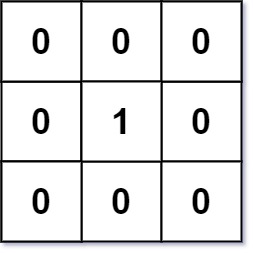
Input: mat = [[0,0,0],[0,1,0],[0,0,0]]
Output: [[0,0,0],[0,1,0],[0,0,0]]
Example 2:
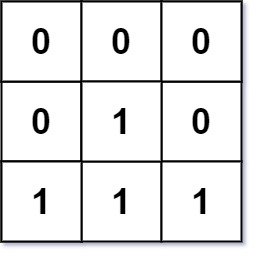
Input: mat = [[0,0,0],[0,1,0],[1,1,1]]
Output: [[0,0,0],[0,1,0],[1,2,1]]
-
Example:
✅ Solution: 01 Matrix — Multi-Source BFS Approach
// ✅ Update Matrix Using Multi-Source BFS (Shortest Distance from 0)

class Solution {
public:
    vector<vector<int>> updateMatrix(vector<vector<int>>& mat) {
        int n = mat.size();
        int m = mat[0].size();

        queue<pair<pair<int, int>, int>> q;
        vector<vector<int>> dis(n, vector<int>(m, 0));
        vector<vector<int>> vis(n, vector<int>(m, 0));

        // Step 1: Push all 0 cells into the queue
        for (int i = 0; i < n; i++) {
            for (int j = 0; j < m; j++) {
                if (mat[i][j] == 0) {
                    vis[i][j] = 1;
                    q.push({{i, j}, 0});
                }
            }
        }

        int dx[4] = {0, 0, 1, -1};
        int dy[4] = {1, -1, 0, 0};

        // Step 2: BFS Traversal
        while (!q.empty()) {
            int x = q.front().first.first;
            int y = q.front().first.second;
            int steps = q.front().second;
            q.pop();

            dis[x][y] = steps;

            for (int i = 0; i < 4; i++) {
                int nx = x + dx[i];
                int ny = y + dy[i];

                if (nx >= 0 && nx < n && ny >= 0 && ny < m && vis[nx][ny] == 0) {
                    vis[nx][ny] = 1;
                    q.push({{nx, ny}, steps + 1});
                }
            }
        }

        return dis;
    }
};
📝 How It Works
- Step 1: Add all
0cells to the queue and mark them as visited. - Step 2: Perform BFS from all
0s simultaneously (Multi-Source BFS):- Each step from the queue gives the distance to the nearest
0. - Mark cells as visited as soon as they are enqueued.
- Each step from the queue gives the distance to the nearest
- Step 3: Return the distance matrix.
✅ Why Multi-Source BFS?
Because the shortest distance to a 0 for each cell is equivalent to the level at which it’s reached in BFS.
🧩 Key Formula / Recurrence
-
BFS Formula:
distance[cell] = steps when cell is first visited from queue. -
4 Direction Movement:
dx = {0, 0, 1, -1}dy = {1, -1, 0, 0}
⏱️ Time & Space Complexity
| Metric | Value |
|---|---|
| Time | O(N × M) |
| Space | O(N × M) |
Where:
- N = Number of rows.
- M = Number of columns.
✅ Every cell is visited exactly once.
⚠️ Edge Cases
- All
0s → Distance matrix stays all0. - All
1s → Not valid as per problem constraints; assumes at least one0. - Single cell grid.
💡 Other Approaches
| Approach | Time Complexity | Notes |
|---|---|---|
| Dynamic Programming | O(N × M) | 2 passes (top-left to bottom-right, then reverse). |
| BFS (Multi-Source) | O(N × M) | Preferred for clarity and simplicity. |
🔁 Related Problems
- Rotting Oranges (Multi-Source BFS)
- Shortest Path in Grid with Obstacles
- Maze Solving Using BFS
- Flood Fill
💬