Rotten Oranges
Problem Statement:
You are given an m x n grid where each cell can have one of three values:
0representing an empty cell,1representing a fresh orange, or2representing a rotten orange.
Every minute, any fresh orange that is 4-directionally adjacent to a rotten orange becomes rotten.
Return the minimum number of minutes that must elapse until no cell has a fresh orange. If this is impossible, return -1.
Example 1:
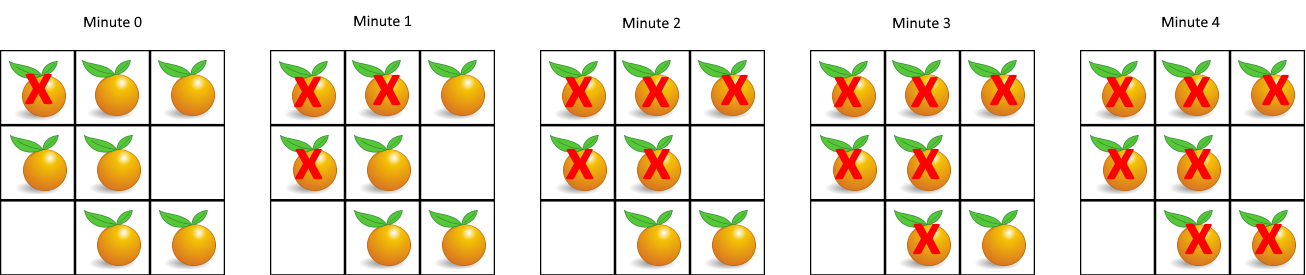
Input: grid = [[2,1,1],[1,1,0],[0,1,1]]
Output: 4
Example 2:
Input: grid = [[2,1,1],[0,1,1],[1,0,1]]
Output: -1
Explanation: The orange in the bottom left corner (row 2, column 0) is never rotten, because rotting only happens 4-directionally.
Example 3:
Input: grid = [[0,2]]
Output: 0
Explanation: Since there are already no fresh oranges at minute 0, the answer is just 0.
-
Example:
✅ Solution: Rotting Oranges — BFS Approach (Multi-Source BFS)
// ✅ BFS Solution for Rotting Oranges in C++

class Solution {
public:
    int orangesRotting(vector<vector<int>>& grid) {
        int n = grid.size();
        int m = grid[0].size();

        queue<pair<int, int>> rottenCoord;
        int totalOranges = 0;
        int totalRottenOranges = 0;
        int minutes = 0;

        // Count total oranges and push initial rotten oranges into queue
        for (int i = 0; i < n; i++) {
            for (int j = 0; j < m; j++) {
                if (grid[i][j] != 0) totalOranges++;
                if (grid[i][j] == 2) rottenCoord.push({i, j});
            }
        }

        int dx[4] = {0, 0, 1, -1};
        int dy[4] = {1, -1, 0, 0};

        while (!rottenCoord.empty()) {
            int k = rottenCoord.size();
            totalRottenOranges += k;

            while (k--) {
                int x = rottenCoord.front().first;
                int y = rottenCoord.front().second;
                rottenCoord.pop();

                for (int i = 0; i < 4; i++) {
                    int nx = x + dx[i];
                    int ny = y + dy[i];

                    if (nx < 0 || ny < 0 || nx >= n || ny >= m || grid[nx][ny] != 1) continue;

                    grid[nx][ny] = 2;
                    rottenCoord.push({nx, ny});
                }
            }

            if (!rottenCoord.empty()) minutes++;
        }

        return totalRottenOranges == totalOranges ? minutes : -1;
    }
};
📝 How It Works
- Step 1: Traverse the grid once:
- Count total oranges (both fresh and rotten).
- Add all rotten oranges to a queue (multi-source BFS).
- Step 2: Standard BFS Loop:
- Process all rotten oranges currently in the queue.
- For each, rot its fresh neighbors and add them to the queue.
- Count time in minutes (increment only if new rotting occurs).
- Step 3: If total rotten oranges at the end equal total oranges, return minutes. Otherwise, return
1.
✅ This handles simultaneous rotting at each minute using BFS level order.
🧩 Key Formula / Recurrence
-
BFS recurrence:
for each rotten orange → rot all 4 neighbors → push newly rotten to queue -
Time Count:
Increment
minutesafter each BFS level.
⏱️ Time & Space Complexity
| Metric | Value |
|---|---|
| Time | O(N × M) |
| Space | O(N × M) |
- N: Number of rows.
- M: Number of columns.
- Each cell is processed at most once.
⚠️ Edge Cases
- No fresh oranges → Return
0. - No rotten oranges initially → Return
1if fresh exists. - Grid fully filled with zeros → Return
0.
💡 Other Approaches
| Approach | Time Complexity | Notes |
|---|---|---|
| BFS (Multi-Source) | O(N × M) | Best and standard. |
| DFS | O(N × M) | Not recommended: complex timing logic. |
🔁 Related Problems
- Number of Islands
- Zombie in Matrix (Multi-Source BFS)
- Shortest Path in Grid with Obstacles
- Fire Spread Simulation
💬