Merge Two Sorted Lists
Problem Statement:
You are given the heads of two sorted linked lists list1 and list2.
Merge the two lists into one sorted list. The list should be made by splicing together the nodes of the first two lists.
Return the head of the merged linked list.
-
Example:
Example 1:
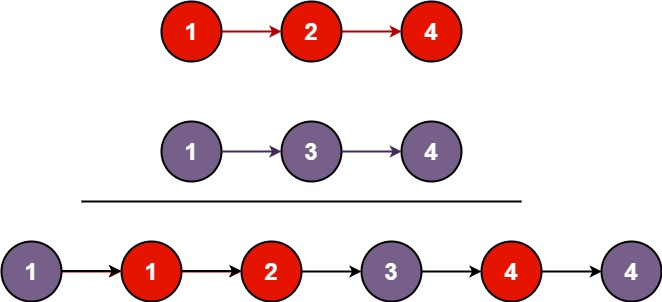
Input: list1 = [1,2,4], list2 = [1,3,4]
Output: [1,1,2,3,4,4]
Example 2:
Input: list1 = [], list2 = []
Output: []
Example 3:
Input: list1 = [], list2 = [0]
Output: [0]
Constraints:
- The number of nodes in both lists is in the range
[0, 50]. 100 <= Node.val <= 100- Both
list1andlist2are sorted in non-decreasing order.
- The number of nodes in both lists is in the range
Solution: Iterative Two-Pointer (Dummy Head)
// Definition for singly-linked list.
struct ListNode {
    int val;
    ListNode *next;
    ListNode(): val(0), next(nullptr) {}
    ListNode(int x): val(x), next(nullptr) {}
    ListNode(int x, ListNode *n): val(x), next(n) {}
};

class Solution {
public:
    ListNode* mergeTwoLists(ListNode* list1, ListNode* list2) {
        // Dummy head simplifies handling the first node
        ListNode* dummyHead = new ListNode(-1);
        ListNode* mergedTail = dummyHead;

        // Merge while both lists have nodes
        while (list1 && list2) {
            if (list1->val <= list2->val) {          // <= keeps relative order (stable)
                mergedTail->next = list1;            // link smaller node
                list1 = list1->next;                 // advance in list1
            } else {
                mergedTail->next = list2;            // link smaller node
                list2 = list2->next;                 // advance in list2
            }
            mergedTail = mergedTail->next;           // advance tail
        }

        // Attach the remaining nodes (only one of these will run)
        if (list1) mergedTail->next = list1;
        if (list2) mergedTail->next = list2;

        ListNode* head = dummyHead->next;
        delete dummyHead;                             // avoid memory leak for dummy
        return head;
    }
};
📝 How It Works
- Use a dummy head and a tail pointer to build the merged list.
- Compare heads of
list1andlist2; attach the smaller one tomergedTail, advance that list andmergedTail. - When one list ends, append the remainder of the other (already sorted).
- Return
dummyHead->nextas the merged list’s head.
Analogy: Like merging two already-sorted queues by always dequeuing the smaller front element.
🧩 Key Formula / Recurrence
-
No DP/recurrence. Core transition is:
If
list1->val <= list2->val→ attachlist1, else attachlist2.
⏱️ Time & Space Complexity
- Time:
O(m + n)— each node visited once. - Space:
O(1)auxiliary — in-place pointer rewiring (no extra nodes), ignoring the dummy node pointer itself.
⚠️ Edge Cases
- One or both lists are
nullptr→ returns the other list directly. - Equal values (
<=) ensures stable merge (preserves original order among equals). - Very long lists: iterative approach avoids recursion stack overflow.
💡 Other Approaches
- Recursive merge: cleaner code, same
O(m+n)time but O(m+n) stack space in worst case. - Collect & sort values:
O((m+n) log(m+n))time, extra space — not recommended.
🔁 Related Problems
- Merge k Sorted Lists (use heap or divide & conquer)
- Sort List (merge sort on linked list)
- Remove Duplicates from Sorted List
💬