Flattening a Linked List
Problem Statement:
Given a linked list containing n head nodes where every node in the linked list contains two pointers:
(i) next points to the next node in the list.
(ii) bottom pointer to a sub-linked list where the current node is the head.
Each of the sub-linked lists nodes and the head nodes are sorted in ascending order based on their data.
Your task is to flatten the linked list such that all the nodes appear in a single level while maintaining the sorted order.
**Note:**1. ↓ represents the bottom pointer and -> represents the next pointer.2. The flattened list will be printed using the bottom pointer instead of the next pointer.
Examples:
Input:

Output: 5-> 7-> 8-> 10 -> 19-> 20-> 22-> 28-> 30-> 35-> 40-> 45-> 50.
Explanation:
Bottom pointer of 5 is pointing to 7.
Bottom pointer of 7 is pointing to 8.
Bottom pointer of 8 is pointing to 10 and so on.

Input:

Output: 5-> 7-> 8-> 10-> 19-> 22-> 28-> 30-> 50
Explanation:
Bottom pointer of 5 is pointing to 7.
Bottom pointer of 7 is pointing to 8.
Bottom pointer of 8 is pointing to 10 and so on.
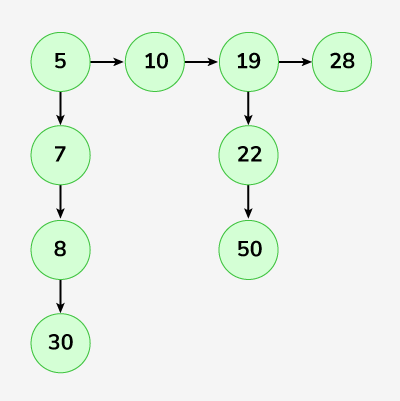
-
Example:
✅ Solution: Recursion + Merge Two Sorted Lists
/*
struct Node{
    int data;
    struct Node * next;
    struct Node * bottom;

    Node(int x){
        data = x;
        next = NULL;
        bottom = NULL;
    }
};
*/

class Solution {
  public:

    // Merges two sorted bottom-linked lists
    Node* merge(Node *list1, Node *list2){
        Node *dummy = new Node(-1);
        Node *tail = dummy;

        while(list1 && list2){
            if(list1->data <= list2->data){
                tail->bottom = list1;
                list1 = list1->bottom;
            } else {
                tail->bottom = list2;
                list2 = list2->bottom;
            }
            tail = tail->bottom;
        }

        // Attach remaining part
        if(list1) tail->bottom = list1;
        else tail->bottom = list2;

        return dummy->bottom;
    }

    // Recursively flattens the list
    Node *flatten(Node *head) {
        if(head == NULL || head->next == NULL) return head;

        // Recursively flatten the next list
        Node *flattenedRest = flatten(head->next);

        // Merge current list with the flattened rest
        head = merge(head, flattenedRest);

        return head;
    }
};
📝 How It Works
- Each node has a
nextpointer (horizontal) and abottompointer (vertical) to a sorted linked list. - The goal is to flatten the list into a single bottom-linked list, preserving sorted order.
- The algorithm works by:
- Recursively flattening the
nextlist. - Merging the current list (
head) with the already-flattened list using a sorted merge logic (like merge step in merge sort).
- Recursively flattening the
- Merging is done using a dummy node and standard sorted linked list merging via
bottompointers.
🧩 Key Concept
This is similar to k-way merge of sorted linked lists, recursively reducing to 2-way merge.
⏱️ Time & Space Complexity
| Operation | Time Complexity | Space Complexity |
|---|---|---|
| Merge of two lists | O(N + M) | O(1) |
| Total recursive merges | O(N * M) in worst case | O(N) call stack |
N: Number ofnextnodesM: Average number ofbottomnodes in each list
Space is O(N) due to recursion stack, merge is done in-place with O(1) extra.
⚠️ Edge Cases
- Empty list: return
NULL. - Only one
nextnode: already flat. - Some bottom lists are
NULL: still valid, handled during merge.
💡 Other Approaches
| Approach | Time | Space |
|---|---|---|
| Recursion + Merge ✅ | O(N * M) | O(N) |
| Min-Heap for k-way merge | O(N log k) | O(k) extra (heap) |
Heap-based approach is more optimal if k is large and performance matters.
🔁 Related Problems
- Leetcode 23: Merge k Sorted Lists
- GFG: Flattening a Linked List
- Leetcode 21: Merge Two Sorted Lists
- Leetcode 430: Flatten a Multilevel Doubly Linked List
🛠️ Real-World Analogy
Imagine next pointers as departments, and bottom lists as sorted employee IDs in that department. Flattening means creating one global sorted list of all employees from all departments.