Odd Even Linked List
Problem Statement:
Given the head of a singly linked list, group all the nodes with odd indices together followed by the nodes with even indices, and return the reordered list.
The first node is considered odd, and the second node is even, and so on.
Note that the relative order inside both the even and odd groups should remain as it was in the input.
You must solve the problem in O(1) extra space complexity and O(n) time complexity.
Example 1:
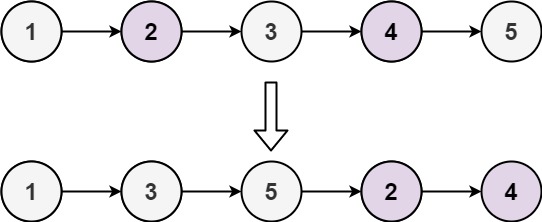
Input: head = [1,2,3,4,5]
Output: [1,3,5,2,4]
Example 2:
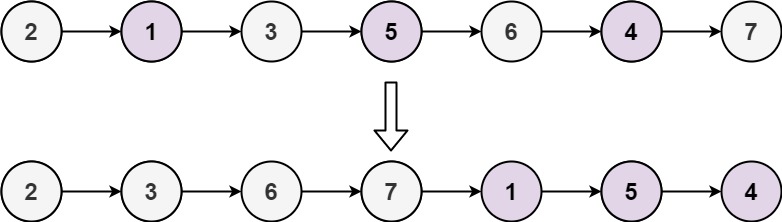
Input: head = [2,1,3,5,6,4,7]
Output: [2,3,6,7,1,5,4]
-
Example:
✅ Solution: In-Place Linked List Reordering
/**
 * Definition for singly-linked list.
 * struct ListNode {
 *     int val;
 *     ListNode *next;
 *     ListNode() : val(0), next(nullptr) {}
 *     ListNode(int x) : val(x), next(nullptr) {}
 *     ListNode(int x, ListNode *next) : val(x), next(next) {}
 * };
 */
class Solution {
public:
    ListNode* oddEvenList(ListNode* head) {

        if(head == NULL || head->next == NULL) return head;

        ListNode *odd = head;               // odd positioned node pointer
        ListNode *even = head->next;        // even positioned node pointer
        ListNode *evenHead = even;          // save start of even list

        while(even != NULL && even->next != NULL){
            odd->next = even->next;         // link odd nodes
            odd = odd->next;

            even->next = odd->next;         // link even nodes
            even = even->next;
        }

        odd->next = evenHead;               // attach even list after odd

        return head;
    }
};
📝 Revision Notes
📝 How It Works
- Split the original list into two:
- One for nodes at odd positions.
- One for nodes at even positions.
- Use two pointers
oddandevento traverse the list in tandem. - At the end, link the last node of the odd list to the head of the even list.
- This rearranges the nodes, maintaining their original relative order within odd/even.
🧩 Key Logic
- Keep two running pointers:
oddandeven, both progressing vianext->next. - When loop finishes, connect end of odd to head of even.
⏱️ Time & Space Complexity
| Metric | Value |
|---|---|
| Time | O(n) |
| Space | O(1) |
⚠️ Edge Cases
- Empty list → return
NULL. - List with 1 node → return as-is.
- List with 2 nodes → no rearrangement needed.
💡 Other Approaches
| Approach | Time | Space | Notes |
|---|---|---|---|
| Brute Force with Arrays | O(n) | O(n) | Uses extra space ❌ |
| Two-pointer in-place | O(n) | O(1) | Optimal ✅ |
🔁 Related Problems
- LC 328 – Odd Even Linked List ✅
- LC 86 – Partition List
- LC 206 – Reverse Linked List
- LC 143 – Reorder List (Zigzag pattern)
💬