Remove Nth Node from End
Problem Statement:
Given the head of a linked list, remove the nth node from the end of the list and return its head.
Example 1:
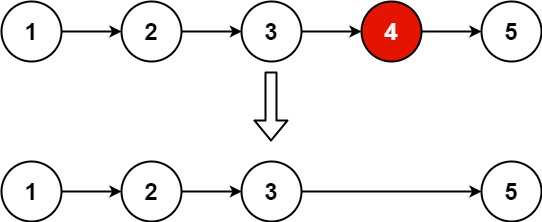
Input: head = [1,2,3,4,5], n = 2
Output: [1,2,3,5]
Example 2:
Input: head = [1], n = 1
Output: []
Example 3:
Input: head = [1,2], n = 1
Output: [1]
-
Example:
✅ Solution: Two Pointer Technique (Fast & Slow Pointers)
class Solution {
public:
    ListNode* removeNthFromEnd(ListNode* head, int n) {
        if(head == NULL) return NULL;

        ListNode *slow = head, *fast = head;

        // Move the fast pointer n steps ahead
        while(n--) {
            fast = fast->next;
        }

        // If fast is NULL, the node to be deleted is the head itself
        if(fast == NULL) return head->next;

        // Move both pointers until fast reaches the end
        while(fast->next != NULL) {
            slow = slow->next;
            fast = fast->next;
        }

        // Delete the nth node from the end
        slow->next = slow->next->next;

        return head;
    }
};
📝 How It Works
- This method uses two pointers (
fastandslow) to identify the node to delete in a single traversal. fastis movednsteps ahead first.- If
fastbecomesNULL, it means we have to remove the head node (i.e.,nequals the length of the list). - Otherwise, we move both pointers forward together until
fast->next == NULL. At this point:slowis just before the node we need to remove.
- We update
slow->nextto skip the node.
🧩 Key Formula / Recurrence
There’s no recurrence here — just a key pointer logic:
When fast reaches the end, slow is at (length - n)-th node (i.e., just before the target node).
⏱️ Time & Space Complexity
| Metric | Complexity |
|---|---|
| ⏱️ Time | O(L), where L is the length of the linked list |
| 🪄 Space | O(1), constant space |
⚠️ Edge Cases
head == NULL→ returnNULLn == length of list→ remove the head node- Only one node in the list → result should be
NULLafter deletion - Deleting the last node (
n == 1) is handled smoothly
💡 Other Approaches
| Approach | Time | Space |
|---|---|---|
| Two-pass (count length first) | O(L) | O(1) |
| Stack-based (store pointers) | O(L) | O(L) |
| Recursive postorder deletion | O(L) | O(L) due to call stack |
🔁 Related Problems
- LC 19. Remove Nth Node From End of List
- LC 876. Middle of the Linked List
- LC 206. Reverse Linked List
- LC 2. Add Two Numbers
💬