Sort Linked List
Problem Statement:
Given the head of a linked list, return the list after sorting it in ascending order.
Example 1:
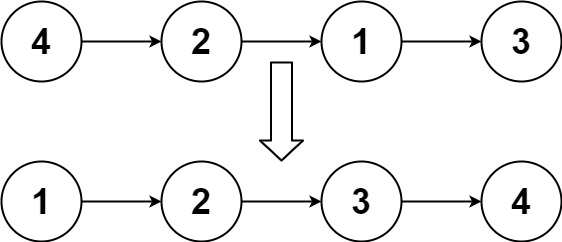
Input: head = [4,2,1,3]
Output: [1,2,3,4]
-
Example:
✅ Solution: Merge Sort (Divide and Conquer)
class Solution {
public:

    // Function to find the middle node of the list
    ListNode *findMiddle(ListNode *head){
        ListNode *slow = head, *fast = head->next;
        while(fast != NULL && fast->next != NULL){
            slow = slow->next;
            fast = fast->next->next;
        }
        return slow;
    }

    // Function to merge two sorted lists
    ListNode *mergeLists(ListNode *left, ListNode *right){
        ListNode *dummy = new ListNode();
        ListNode *temp = dummy;

        while(left != NULL && right != NULL){
            if(left->val <= right->val){
                temp->next = left;
                left = left->next;
            }
            else{
                temp->next = right;
                right = right->next;
            }
            temp = temp->next;
        }

        if(left != NULL) temp->next = left;
        else temp->next = right;

        return dummy->next;
    }

    // Merge Sort: recursively split and merge
    ListNode* sortList(ListNode* head) {
        if(head == NULL || head->next == NULL) return head;

        ListNode *middleNode = findMiddle(head);

        ListNode *right = middleNode->next;
        middleNode->next = NULL;  // Break the list into two halves
        ListNode *left = head;

        left = sortList(left);
        right = sortList(right);

        return mergeLists(left, right);
    }
};
📝 How It Works
This is the Merge Sort algorithm adapted for linked lists, which avoids using extra space (unlike array merge sort). Here's how it works:
- Base Case: If the list is empty or has only one node, it's already sorted.
- Split Phase:
- Use the slow-fast pointer approach to find the middle.
- Cut the list into two halves.
- Recursion: Recursively sort both halves.
- Merge Phase:
- Merge the two sorted halves using a dummy node and pointer manipulation.
This technique ensures the list gets sorted in O(n log n) time using only O(1) auxiliary space for list nodes.
🧩 Key Formula / Recurrence
-
The recursive recurrence:
T(n) = 2*T(n/2) + O(n)Which solves to
T(n) = O(n log n)
⏱️ Time & Space Complexity
| Metric | Complexity |
|---|---|
| ⏱️ Time | O(n log n) — standard merge sort |
| 🪄 Space | O(log n) — due to recursive stack calls (no array-based space) |
⚠️ Edge Cases
- ✅ Empty list → returns
NULL - ✅ Single node → already sorted
- ✅ Already sorted list → returned as is
- ✅ All elements same → still handled correctly
- ✅ List with negative and positive integers → handled properly
💡 Other Approaches
| Approach | Time | Space | Notes |
|---|---|---|---|
| Merge Sort | O(n log n) | O(log n) | ✅ Optimal |
| Array Sort | O(n log n) | O(n) | Copy values to array, sort, write back |
| Insertion Sort | O(n²) | O(1) | ❌ Too slow for large lists |
🔁 Related Problems
- LeetCode 148. Sort List
- LeetCode 21. Merge Two Sorted Lists
- LeetCode 876. Middle of the Linked List
- LeetCode 23. Merge k Sorted List
💬