Starting Point of Loop
Problem Statement:
Given the head of a linked list, return the node where the cycle begins. If there is no cycle, return null.
There is a cycle in a linked list if there is some node in the list that can be reached again by continuously following the next pointer. Internally, pos is used to denote the index of the node that tail's next pointer is connected to (0-indexed). It is -1 if there is no cycle. Note that pos is not passed as a parameter.
Do not modify the linked list.
Example 1:
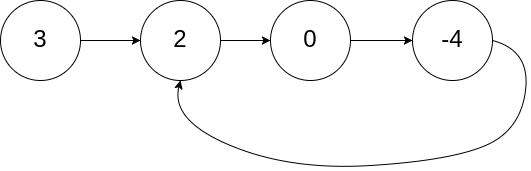
Input: head = [3,2,0,-4], pos = 1
Output: tail connects to node index 1
Explanation: There is a cycle in the linked list, where tail connects to the second node.
Example 2:
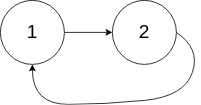
Input: head = [1,2], pos = 0
Output: tail connects to node index 0
Explanation: There is a cycle in the linked list, where tail connects to the first node.
Example 3:

Input: head = [1], pos = -1
Output: no cycle
Explanation: There is no cycle in the linked list.
-
Example:
✅ Solution: Floyd’s Cycle Detection (Detect Starting Node)
class Solution {
public:
    ListNode *detectCycle(ListNode *head) {
        ListNode *slow = head;
        ListNode *fast = head;
        bool isCycle = false;

        // Step 1: Detect cycle using Floyd’s Algorithm
        while(fast != NULL && fast->next != NULL){
            slow = slow->next;
            fast = fast->next->next;

            if(slow == fast){
                isCycle = true;
                break;
            }
        }

        // Step 2: Find starting point of cycle
        if(isCycle){
            slow = head;
            while(slow != fast){
                slow = slow->next;
                fast = fast->next;
            }
            return slow;  // Starting node of the cycle
        }

        return NULL;  // No cycle
    }
};
📝 How It Works
- Phase 1: Cycle Detection
- Use two pointers:
slow(moves 1 step) andfast(moves 2 steps). - If they meet, a cycle is present.
- Use two pointers:
- Phase 2: Finding the Start of Cycle
- Reset
slowtohead. - Move both
slowandfastone step at a time. - The point where they meet again is the start of the cycle.
- Reset
🧩 Key Logic
-
Cycle exists when
fast == slow. -
From meeting point, both pointers move at same pace:
slow = head;
while(slow != fast) {
    slow = slow->next;
    fast = fast->next;
}
return slow;
⏱️ Time & Space Complexity
| Metric | Value |
|---|---|
| Time | O(N) |
| Space | O(1) |
- Only two pointers used.
- Fast and slow both take linear time in worst case.
⚠️ Edge Cases
headisNULL- Cycle starts at head itself
- Very small list (1–2 nodes)
- No cycle exists
💡 Other Approaches
| Method | Time | Space | Description |
|---|---|---|---|
| HashSet Tracking | O(N) | O(N) | Store visited nodes |
| Floyd's Algo | O(N) | O(1) | Most optimal approach ✅ |
🔁 Related Problems
💬