Largest Rectangle in Histogram
Problem Statement:
Given an array of integers heights representing the histogram's bar height where the width of each bar is 1, return the area of the largest rectangle in the histogram.
Example 1:
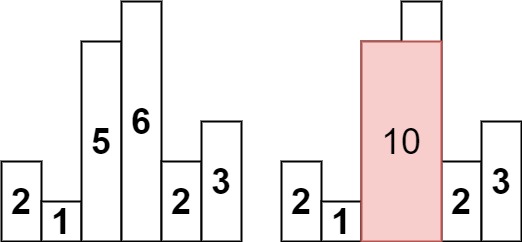
Input: heights = [2,1,5,6,2,3]
Output: 10
Explanation: The above is a histogram where width of each bar is 1.
The largest rectangle is shown in the red area, which has an area = 10 units.
Example 2:
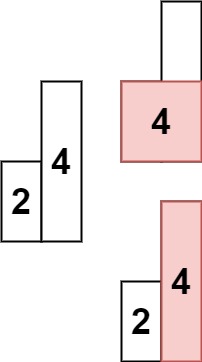
Input: heights = [2,4]
Output: 4
-
Example:
✅ Solution: Monotonic Stack — Largest Rectangle in Histogram
class Solution {
public:
    int largestRectangleArea(vector<int>& heights) {
        int maxArea = 0;
        stack<int> st;
        int n = heights.size();

        for (int i = 0; i <= n; i++) {
            while (!st.empty() && (i == n || heights[st.top()] >= (i == n ? 0 : heights[i]))) {
                int height = heights[st.top()];
                st.pop();

                int width = st.empty() ? i : i - st.top() - 1;
                maxArea = max(maxArea, height * width);
            }
            st.push(i);
        }
        return maxArea;
    }
};
📝 How It Works
-
Goal: Find the largest rectangular area in a histogram.
-
Technique:
Use a monotonic increasing stack to keep track of bar indices.
-
Step-by-Step:
- Traverse from left to right.
- When the current bar is lower than the bar at the stack's top, we pop from the stack.
- For each popped bar, calculate the width:
- If stack is empty → width =
i(from beginning toi - 1). - Otherwise → width =
i - st.top() - 1(between two smaller bars).
- If stack is empty → width =
- Update
maxAreausingheight * width. - Push the current index onto the stack.
-
Why
i == nloop condition:We need one extra iteration to flush out remaining bars in the stack after processing all indices.
🧩 Key Formula
For each popped bar height = heights[st.top()]:
width = (st.empty() ? i : i - st.top() - 1)area = height * widthmaxArea = max(maxArea, area)
⏱️ Time & Space Complexity
| Approach | Time Complexity | Space Complexity |
|---|---|---|
| Monotonic Stack | O(N) | O(N) |
- Every bar is pushed and popped at most once.
⚠️ Edge Cases
- All bars of same height.
- Increasing heights (e.g.,
[1, 2, 3, 4, 5]). - Decreasing heights (e.g.,
[5, 4, 3, 2, 1]). - Single bar → Area is just height itself.
💡 Other Approaches
| Approach | Time Complexity | Notes |
|---|---|---|
| Brute Force | O(N²) | Check all rectangles for each height. Too slow for large N. |
| Divide & Conquer | O(N log N) | Recursive max-min partitioning approach. Harder to implement. |
🔁 Related Problems
- LeetCode 84: Largest Rectangle in Histogram (Exact Problem)
- LeetCode 85: Maximal Rectangle
- LeetCode 42: Trapping Rain Water
- LeetCode 907: Sum of Subarray Minimums
🛠️ Other Notes
-
✅ This is a classic monotonic stack template.
-
✅ Real-world analogy:
Finding the largest rectangular billboard possible along a skyline of buildings.
-
✅ Remember: Always push indices instead of values to calculate widths properly!
💬