Trap Rain Water
Problem Statement:
Given n non-negative integers representing an elevation map where the width of each bar is 1, compute how much water it can trap after raining.
Example 1:
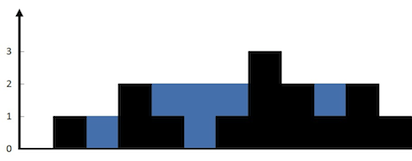
Input: height = [0,1,0,2,1,0,1,3,2,1,2,1]
Output: 6
Explanation: The above elevation map (black section) is represented by array [0,1,0,2,1,0,1,3,2,1,2,1]. In this case, 6 units of rain water (blue section) are being trapped.
Example 2:
Input: height = [4,2,0,3,2,5]
Output: 9
-
Example:
✅ Solution: Two-Pointer (Space Optimized)
class Solution {
public:
    int trap(vector<int>& height) {
        int n = height.size();
        int left = 0, right = n - 1;
        int leftMax = 0, rightMax = 0;
        int res = 0;

        while (left <= right) {
            if (height[left] <= height[right]) {
                if (height[left] >= leftMax) {
                    leftMax = height[left];
                } else {
                    res += leftMax - height[left];
                }
                left++;
            } else {
                if (height[right] >= rightMax) {
                    rightMax = height[right];
                } else {
                    res += rightMax - height[right];
                }
                right--;
            }
        }
        return res;
    }
};
✅ Solution: Prefix-Suffix Arrays (Tabulation)
class Solution {
public:
    int trap(vector<int>& height) {
        int n = height.size();
        if (n == 0) return 0;

        vector<int> leftMax(n), rightMax(n);

        leftMax[0] = height[0];
        for (int i = 1; i < n; i++) {
            leftMax[i] = max(leftMax[i - 1], height[i]);
        }

        rightMax[n - 1] = height[n - 1];
        for (int i = n - 2; i >= 0; i--) {
            rightMax[i] = max(rightMax[i + 1], height[i]);
        }

        int res = 0;
        for (int i = 0; i < n; i++) {
            res += min(leftMax[i], rightMax[i]) - height[i];
        }

        return res;
    }
};
✅ Solution: Brute Force (Naive)
class Solution {
public:
    int trap(vector<int>& height) {
        int n = height.size();
        int res = 0;

        for (int i = 0; i < n; i++) {
            int leftMax = height[i];
            for (int j = 0; j <= i; j++) {
                leftMax = max(leftMax, height[j]);
            }

            int rightMax = height[i];
            for (int j = i; j < n; j++) {
                rightMax = max(rightMax, height[j]);
            }

            res += min(leftMax, rightMax) - height[i];
        }

        return res;
    }
};
📝 How It Works
-
This is the classic Trapping Rain Water problem.
-
For each bar, the water it can trap is determined by:
min(max height to its left, max height to its right) - height of the bar -
Three Approaches:
-
Brute Force:
For each index, scan both left and right to find max heights.
-
Prefix-Suffix Arrays:
Precompute
leftMax[i]andrightMax[i]for alli.This avoids redundant max searches.
-
Two-Pointer:
Optimizes both time and space.
We maintain two pointers and update
leftMaxandrightMaxon the fly.If
height[left] <= height[right], we processleft.Otherwise, we process
right.
🧩 Key Formula / Recurrence
-
For each
i:water[i] = min(leftMax[i], rightMax[i]) - height[i] -
Where:
leftMax[i] = max(height[0..i])rightMax[i] = max(height[i..n-1])
⏱️ Time & Space Complexity
| Approach | Time Complexity | Space Complexity |
|---|---|---|
| Brute Force | O(N²) | O(1) |
| Prefix-Suffix Arrays | O(N) | O(N) |
| Two-Pointer | O(N) | O(1) |
⚠️ Edge Cases
- Empty array.
- All bars have the same height.
- Bars in strictly increasing or decreasing order.
- Only two bars (cannot trap water).
💡 Other Approaches
-
Stack-Based Method: Maintains a stack of indices, using a monotonic stack.
Time: O(N), Space: O(N).
More complex than two-pointers for this problem, so less preferred.
🔁 Related Problems
- LeetCode 11: Container With Most Water
- LeetCode 42: Trapping Rain Water
- LeetCode 407: Trapping Rain Water II
- LeetCode 84: Largest Rectangle in Histogram
🛠️ Other Notes
-
Real-World Analogy:
Think of city skylines where water gets trapped between tall buildings after rain.
You only care about the tallest buildings on the left and right sides for each spot.
-
✅ Among all approaches, two-pointer is most efficient in practice with O(N) time and O(1) space.
-
✅ Prefix-suffix arrays are easier to implement and reason about for beginners.